
An Aircraft’s Natural Instinct for Stability
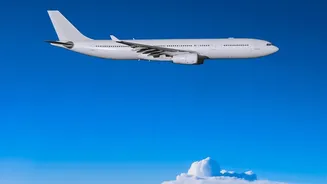
Before any pilot action or computer correction, it's important to know that commercial aircraft are designed to be inherently stable. Engineers build them with features that naturally resist disruptions and encourage a return to straight-and-level flight.
This is called positive static stability. Think of it like a pendulum or a weathervane; design elements like the placement of the wings and the size of the tail cause the aircraft to want to correct itself after a disturbance. This built-in stability provides the foundational layer of safety, ensuring that the aircraft doesn't immediately enter an uncontrolled state when something unexpected happens. It gives the pilots and the onboard systems a stable platform to work from.
Technology’s Role: The Fly-By-Wire System
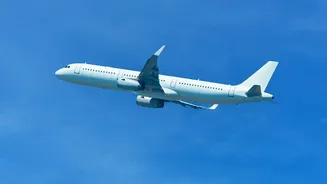
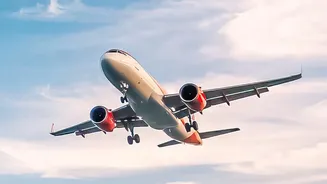
In modern airliners like the Airbus A320 family, pilots don't have direct mechanical control over the flight surfaces via cables and pulleys. Instead, they use a system called 'fly-by-wire' (FBW). When a pilot makes an input on their sidestick or yoke, that command is sent as an electronic signal to a suite of flight control computers. These computers analyze the pilot's request in the context of the aircraft's current speed, altitude, and other factors. They then send precise instructions to actuators that move the control surfaces (ailerons, elevators, rudder) to achieve the desired outcome. A huge advantage of FBW is its ability to act as a safety net, automatically making constant, tiny adjustments to dampen oscillations and maintain a smooth flight path. The system is designed with multiple redundancies, often having three or four backup computers to prevent failure.
Handling Severe Turbulence
For light to moderate turbulence, the autopilot is more than capable of handling the minor corrections needed to hold its heading and altitude. However, in the rare event of severe turbulence, the procedure changes. Pilots will often reduce the aircraft’s speed to a specific “turbulence penetration speed,” which reduces structural loads. While some guidelines suggest keeping the autopilot engaged to prevent overcorrection, pilots may disengage it if it's not performing as desired. When flying manually through severe turbulence, the priority isn't to fight every bump to maintain a perfect altitude. Instead, pilots make smooth, deliberate inputs to maintain the aircraft's pitch and roll attitude, allowing the plane to ride the waves of air while ensuring it remains in a safe and controlled state.
Training for the Unthinkable
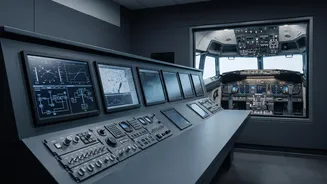
Pilots don't just learn how to handle emergencies on the job; they spend hundreds of hours in advanced flight simulators practicing for them. These simulators can replicate a vast range of worst-case scenarios, from engine failures on takeoff to electrical fires and complete hydraulic system malfunctions. This training is designed to build muscle memory for critical immediate actions. For an event like an engine failure, pilots drill a specific sequence of memory items, often guided by mnemonics like "ABCDE" (Airspeed, Best place to land, Checklist, Declare, Execute). The goal is to ensure that when an emergency happens, the response is immediate, systematic, and calm. This constant, repetitive training ensures that even the most startling event is met with a practiced and proven procedure.
The Human Element: Crew Resource Management
Beyond technology and individual skill, modern aviation safety hinges on a concept called Crew Resource Management (CRM). First developed in the late 1970s, CRM is a set of training procedures that emphasizes teamwork, effective communication, and joint decision-making on the flight deck. It moves away from a rigid, authoritarian culture to one where first officers are encouraged to voice concerns and question captains if they spot a potential error. During a major disruption, CRM ensures that the pilots work together as a cohesive team, managing their workload, cross-checking actions, and using all available resources—including cabin crew, air traffic control, and dispatchers—to solve the problem safely and efficiently.