







What Is the Summer Solstice?
The summer solstice marks the official start of astronomical summer in the Northern Hemisphere. For us on the ground, it's known more simply as the 'longest day of the year'. This year, it falls on June 21. On this day, the sun reaches its highest and
northernmost point in the sky, resulting in the maximum duration of daylight. From this point forward, the days will slowly but surely begin to shorten as we head towards the winter solstice in December. It’s a moment of peak sunshine, a celestial turning point that has been observed by cultures around the world for millennia.
The Science of the Tilt
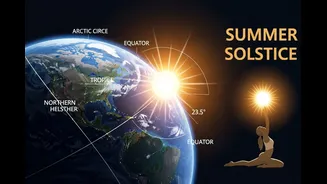
The magic behind the solstice isn't the sun moving, but our planet’s orientation. Earth orbits the sun on a tilted axis, leaning at an angle of about 23.5 degrees. This tilt is the hero of our story, the reason we have seasons. During the June solstice, the Northern Hemisphere is tilted most directly towards the sun. Think of it like holding a cricket ball and tilting the top half towards a lamp; that top half gets the most direct light and heat. Because of this direct angle, the sun’s rays hit our part of the world more intensely and for a longer period, giving us those extended hours of glorious daylight. It’s a beautiful, simple piece of celestial mechanics that governs the rhythm of our year.
A 'Geometric Shift' Explained
The phrase 'geometric solstice shifts' might sound complex, but it simply refers to this precise alignment. It’s not a sudden, jarring 'shift' but the exact point in Earth's orbit where our tilt is at its maximum inclination toward the sun. This geometry dictates the path the sun appears to take across our sky. On the solstice, that path is at its longest and highest. The 'shift' is the gradual change that follows; after this peak, the Earth continues its orbit, and the Northern Hemisphere will begin to tilt away from the sun, leading to shorter days and the eventual arrival of winter. So, the geometric shift is less an event and more a peak on a continuous, cyclical journey.
Does the Longest Day Mean the Hottest Day?
It’s a common misconception that the longest day is also the hottest. While the solstice provides the most solar energy, it takes time for the Earth’s land and oceans to absorb this heat and then release it back into the atmosphere. This phenomenon is called 'seasonal lag'. It’s why the hottest days of summer in India and across the Northern Hemisphere typically arrive in July or even August, weeks after the solstice. Think of it like boiling a pot of water; even after you turn the stove to its highest setting, it takes a few minutes for the water to reach its boiling point. The solstice is when the stove is turned to max, but the peak heat comes a little later.
How India Experiences the Solstice
Across India, the effect is clear. In cities like Delhi or Mumbai, sunrise happens early and sunset occurs late, giving residents over 13.5 hours of daylight. This peak of summer heat and light also coincides with a much-anticipated event: the arrival of the monsoon. The intense heating of the Indian subcontinent during these long, sun-drenched days is a key driver of the low-pressure system that pulls moisture-laden winds from the Indian Ocean, heralding the start of the rainy season. So, while we enjoy the extended daylight, the solstice is also a crucial part of the larger climate pattern that defines India’s agricultural and cultural calendar. It’s the final, brightest bow of the hot season before the relief of the rains.