

A Mission to Find Hidden Worlds
Scheduled to launch by May 2027, the Nancy Grace Roman Space Telescope is NASA's next great observatory, designed to unravel cosmic mysteries on an unprecedented scale. While its Wide Field Instrument will map the universe 100 times faster than Hubble,
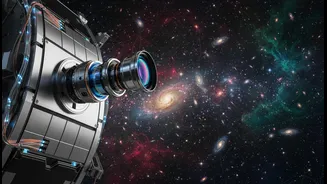
its other key instrument is a technological pathfinder with an audacious goal: to directly photograph planets orbiting distant stars. This is the job of the Coronagraph Instrument, a complex system of masks, prisms, and mirrors. A coronagraph works by blocking the overwhelming glare of a star, much like using a sun visor in your car, to reveal the faint light of any planets orbiting it. Success would give scientists a direct look at these worlds, allowing them to study their atmospheres and compositions. But to achieve this, the telescope must overcome an enemy from within.
The Enemy Within: Microvibrations
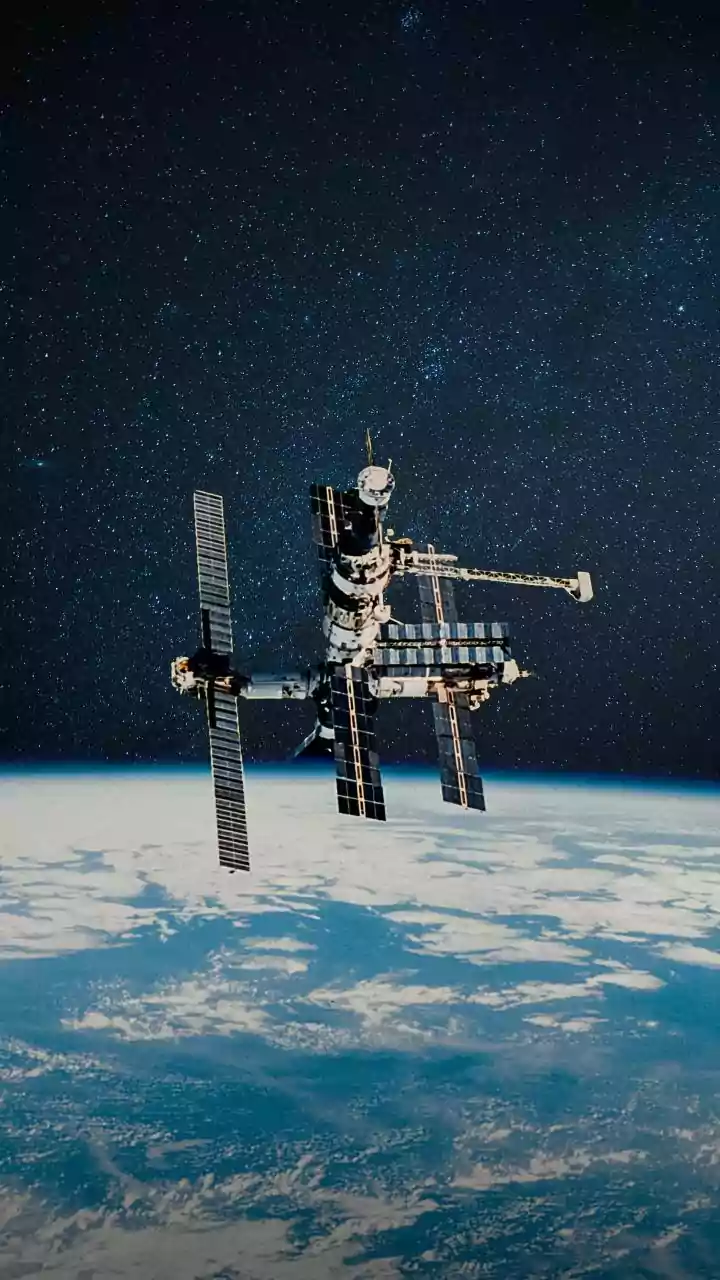
Every spacecraft is a living machine, humming with activity. Reaction wheels spin to keep it pointed, and cooling systems work to keep its sensitive electronics from overheating. While essential for operation, these moving parts create tiny tremors known as microvibrations. For most missions, these vibrations are negligible. But for Roman’s Coronagraph, they are a potential disaster. The instrument is so sensitive that even the slightest jitter can cause starlight to leak around its internal masks, completely washing out the faint signal of a distant planet. The challenge is akin to trying to photograph a firefly next to a searchlight from miles away, while standing on a subtly vibrating platform. To succeed, Roman’s coronagraph needs a level of stability that is almost absolute, isolating it from the rest of the spacecraft.
The Quietest Test
To solve the vibration problem, engineers developed a sophisticated multi-stage isolation system. Recently, the Coronagraph Instrument underwent a series of critical ground tests to ensure this system works as planned. These weren't just about ensuring the electrical components played nice with the rest of the observatory. The main event involved subjecting the instrument to simulated space conditions within a vacuum chamber to prove it could achieve the required stability. The system features active components, including two self-flexing, or deformable, mirrors that change their shape in real-time to compensate for any disturbances. This makes it the first 'active' coronagraph to fly in space, capable of adapting to tiny changes in the observatory's optics. The tests were a resounding success, confirming that the isolation technology could suppress vibrations to an astonishing degree, paving the way for the instrument to perform its delicate task in space.
Seeing the Unseen
With this milestone achieved, the Roman Coronagraph is set to become a game-changer. While current telescopes have struggled to directly see planets, Roman’s technology demonstration is expected to perform 100 to 1,000 times better than existing space-based coronagraphs. This will allow it to directly image large, gaseous exoplanets, potentially capturing the first-ever images of worlds similar in size to Jupiter. More importantly, the lessons learned and technologies proven by the Roman Coronagraph will be foundational for future missions. They will inform the design of even more powerful telescopes, like the proposed Habitable Worlds Observatory, which aims to take the ultimate step: directly imaging Earth-like planets orbiting Sun-like stars. The ability to block starlight with such precision is the key that could one day unlock the first direct evidence of a world that looks like our own.