


The 'New Star' in the Sky
For over a year, starting in October 1604, sky-watchers across Europe and Asia were mesmerized by a guest star in the constellation Ophiuchus. At its peak, it outshone Jupiter and was even visible during the day for several weeks. The German astronomer
Johannes Kepler documented it so meticulously that the event was later named Kepler's Supernova. At the time, scientific belief, heavily influenced by ancient philosophers, held that the heavens were perfect and unchanging. This 'stella nova', or new star, directly challenged that idea. Observers like Kepler concluded it must be far away, among the 'fixed' stars, proving that the cosmos was more dynamic than anyone had imagined. Little did they know, they were witnessing the last supernova to be seen with the naked eye in our own Milky Way galaxy.
What Is a Nova?
The term 'nova' is Latin for 'new', and it describes a star that suddenly becomes dramatically brighter. For centuries, any such event was called a nova. Today, we know a classical nova is a specific kind of explosion that happens in a binary star system—where two stars orbit each other. The setup involves a white dwarf, the dense, collapsed core of a star like our Sun, and a larger companion star. The white dwarf's powerful gravity pulls hydrogen gas from its partner. This gas accumulates on the white dwarf's surface, becoming hotter and denser until it triggers a runaway thermonuclear reaction—a massive hydrogen bomb explosion on the star's surface. The star brightens immensely but, crucially, the white dwarf itself survives the blast and can repeat the process, leading to 'recurrent novae'.
The Supernova: A Star's Grand Finale
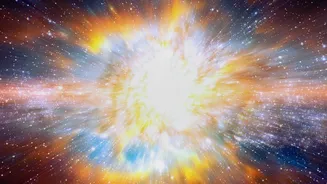
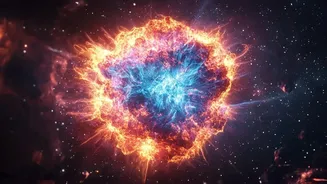
A supernova is a different beast entirely. It is not a surface-level eruption but the complete, catastrophic destruction of a star. While a nova might shine as brightly as 100,000 Suns, a supernova can briefly outshine its entire galaxy, releasing billions of times more energy. There are two main paths to this cosmic finale. One involves a massive star running out of fuel and collapsing under its own gravity. The other, known as a Type Ia supernova, starts similarly to a nova, with a white dwarf in a binary system. However, in this case, the white dwarf siphons off so much material that its total mass exceeds a critical limit known as the Chandrasekhar limit, about 1.4 times the mass of our Sun. This triggers an unstoppable chain reaction that detonates the entire white dwarf.
Kepler's Star: The Final Verdict
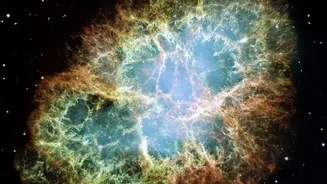
Modern astronomers, using powerful telescopes to study the expanding cloud of debris left behind, have confirmed that Kepler's Star was a Type Ia supernova. The chemical signature of the remnant, which shows elements like silicon but lacks hydrogen, is a key clue. If it had been a classical nova, the star would have survived and likely erupted again. Instead, the 1604 event was a one-time, terminal explosion that completely obliterated the white dwarf star. The remnant we see today, about 20,000 light-years from Earth, is the fading ghost of that four-centuries-old blast.
Why the Distinction Matters
The difference between a nova and a supernova is fundamental to our understanding of the universe. Novae are fascinating, recurring flashes, but their impact is largely local. Supernovae, on the other hand, are universe-shapers. The immense energy of a supernova forges heavy elements—like the iron in our blood and the calcium in our bones—and blasts them across the galaxy, seeding new stars and planets. Furthermore, because Type Ia supernovae like Kepler's all detonate with a remarkably consistent peak brightness, astronomers use them as 'standard candles' to measure cosmic distances and map the expansion of the universe. They are the lighthouses that helped us discover the mysterious dark energy that is accelerating the cosmos.