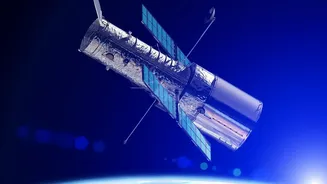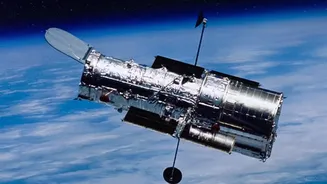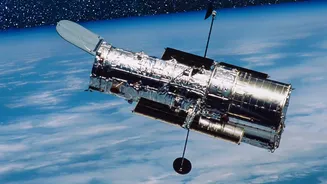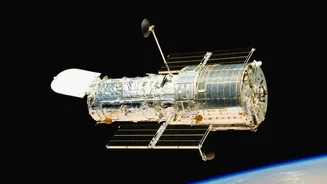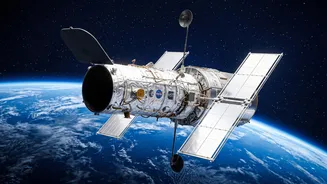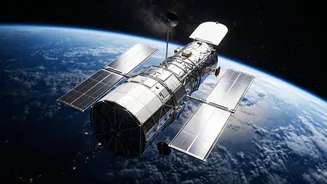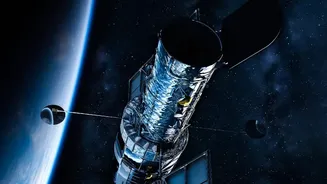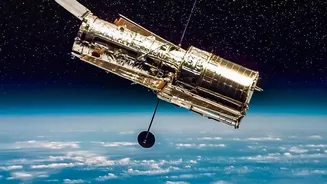



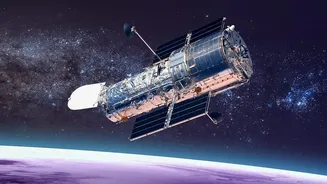

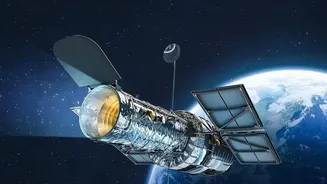
The Hubble Space Telescope, an icon that has redefined our view of the cosmos for over 35 years, is slowly falling. Now, NASA is turning to the private sector for ideas to save it, opening a new chapter in space commercialisation.
Why Hubble Needs a Boost
Like any object in low-Earth
orbit, the Hubble Space Telescope is subject to faint atmospheric drag. With no propulsion system of its own, this constant, gentle friction causes its orbit to gradually decay. Since its last service mission by the Space Shuttle in 2009, its altitude has steadily dropped. Current projections estimate that without intervention, the legendary observatory will make an uncontrolled reentry into Earth's atmosphere sometime between 2033 and 2034. This gradual fall is accelerated by solar activity, which heats and expands the upper atmosphere, increasing drag on the school-bus-sized satellite. To prevent the loss of this invaluable scientific asset, NASA needs to find a way to push it into a higher, more stable orbit.
A Call for Commercial Ideas
In a clear signal of its evolving strategy, NASA has issued a formal Request for Information (RFI), inviting commercial space companies to propose solutions. This isn't a contract for a mission, but rather a market survey to gauge what's possible. The agency has laid out three potential options: boost Hubble to a higher orbit of at least 600 kilometers, service the telescope with new hardware to enhance its capabilities, or conduct a safe, controlled deorbit mission to dispose of it safely. This move reflects NASA's broader shift toward public-private partnerships, leveraging commercial innovation for missions that were once the exclusive domain of government agencies. The agency has explicitly stated it currently has no budget allocated for a Hubble rescue, making this RFI a crucial first step to understand the costs and technical readiness of the private sector before committing funds.
Who Are the Potential Players?
This isn't the first time a commercial Hubble boost has been discussed. In 2022, NASA and SpaceX signed an unfunded Space Act Agreement to study the feasibility of using a Dragon spacecraft for such a mission, a concept championed by the Polaris Program. However, that study did not lead to a funded mission, and NASA later stated it was not pursuing a reboost at that time. This new, broader RFI opens the door to the entire industry. While a crewed mission like the one previously studied is one possibility, the growing satellite-servicing industry means robotic solutions are also strong contenders. Companies developing orbital tugs and in-space servicing vehicles are expected to show significant interest, potentially offering more cost-effective options than a human spaceflight mission.
What a Rescue Would Mean
Successfully reboosting Hubble would do more than just save it from a fiery end. Pushing it to an orbit of 600 kilometers could extend its operational life by 15 to 25 years. This would allow it to continue its groundbreaking scientific work, gathering more data and making new discoveries well into the next decade. Critically, it would ensure Hubble can continue to operate alongside the James Webb Space Telescope. The two observatories are complementary, with Hubble observing in visible and ultraviolet light, while Webb focuses on the infrared spectrum. Losing Hubble would create a gap in our space-based visible light observation capabilities that might not be filled until the Habitable Worlds Observatory launches in the 2040s. Extending Hubble's mission ensures this vital scientific window on the universe remains open.