





So, It's Not Just Spicy Ginger?
Let's clear this up first: galangal is not a substitute for ginger. While they are related members of the Zingiberaceae family, along with turmeric and cardamom, their flavour profiles are worlds apart. Ginger is known for its pungent, spicy warmth and subtle
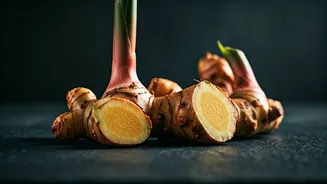
sweetness. Galangal, on the other hand, delivers a completely different experience. Its taste is sharp, peppery, and complex, with distinct citrusy and pine-like notes. Visually, you can spot the difference too. Galangal typically has smoother, paler skin, sometimes with a pinkish tint, and its flesh is much harder and more fibrous than ginger's. You can’t easily grate galangal; it needs to be thinly sliced or pounded to release its aromatic oils.
Meet the Family: Greater and Lesser Galangal
To add another layer of interest, 'galangal' isn't just one thing. The two most common varieties are greater and lesser galangal. Greater galangal (Alpinia galanga) is what you'll most likely find in markets catering to Southeast Asian cuisines. It’s larger, milder, and carries those signature pine and citrus notes that are crucial in Thai cooking. Lesser galangal (Alpinia officinarum), native to China, is smaller, redder, and packs a more pungent, peppery punch. While less common in fresh form outside of Asia, it has a long history in European and Arab cultures, where it was once a prized medicinal spice known as 'galingale'.
The Heartbeat of Southeast Asian Cuisine
In countries like Thailand, Indonesia, Malaysia, and Vietnam, galangal is not just an ingredient; it's a foundation. It is an essential component of countless curry pastes, providing a fragrant depth that ginger simply can't replicate. It is the soul of iconic Thai soups like the hot and sour Tom Yum and the creamy, coconut-based Tom Kha Gai, where its aroma defines the broth. In Indonesia and Malaysia, it’s pounded into the spice paste for rich, complex dishes like beef rendang. The pieces are often left in soups for infusion and are not meant to be eaten due to their tough texture.
More Than a Flavouring Agent
Like many of its rhizome relatives, galangal has a long history of use in traditional medicine. In both Ayurveda and Traditional Chinese Medicine, it has been used for centuries to aid digestion, reduce inflammation, and alleviate stomach issues. It was considered a warming herb, believed to improve circulation and help with respiratory ailments. While modern science is still exploring these claims, studies have noted that galangal is rich in antioxidants and may have anti-inflammatory and antimicrobial properties. In medieval Europe, it was even dubbed the "spice of life" and used to treat everything from bad breath to fevers.
Bringing Galangal Home
Ready to give it a try? Look for fresh galangal in Asian markets or the international section of larger supermarkets. Choose rhizomes that are firm, plump, and free from shriveling or mould. To store it, you can refrigerate the unpeeled root in a paper bag for two to three weeks. For longer storage, it freezes exceptionally well. Simply slice it into thin coins, place them in a single layer in a freezer bag, and store for up to a year. You can add the frozen slices directly to simmering soups and curries—no thawing required.