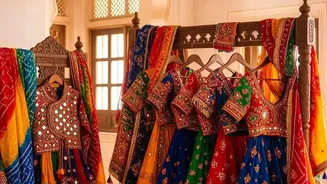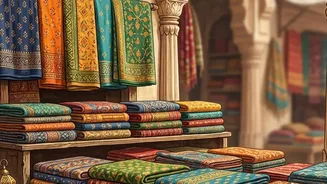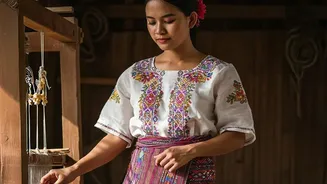






In the world of textiles, some fabrics are decorated after they are made. But in the magical art of Jamdani, the pattern and the cloth are born at the same time, an intricate dance of threads creating motifs that seemingly float on the fabric.
The Art of Woven Air
Jamdani
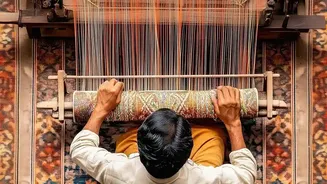
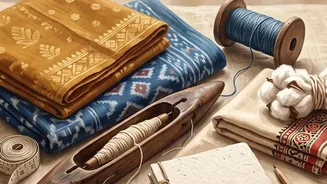
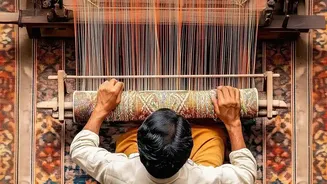
is not embroidery, nor is it printed. It is a supplementary weft technique, where each motif is painstakingly created by hand, directly on the loom, as the fabric itself is being woven. Originating in the Bengal region, this art form traditionally used fine muslin cotton, creating a fabric so light and sheer it was poetically dubbed 'woven air'. This method involves two weavers sitting side-by-side at a handloom. While one manages the base weave, the other uses fine needles or bamboo sticks to interlace thicker, decorative threads into the warp, following a pattern that is often committed to memory. The result is a textile where the design is an integral part of its structure, not just an embellishment on its surface.
A Legacy of Royal Patronage
The history of Jamdani is as rich as its texture, with its golden age flourishing under the patronage of the Mughal emperors. They prized Jamdani for its exquisite fineness and commissioned elaborate garments, making it a symbol of royalty and luxury. The name itself is believed to be of Persian origin, combining 'Jam' (flower) and 'Dani' (vase), a nod to the intricate floral patterns that are a hallmark of the craft. However, the arrival of the British and their industrial-scale mills in Manchester marked a period of sharp decline. The colonial government's policies favoured machine-made textiles, nearly extinguishing this centuries-old handloom tradition.
Global Recognition and Regional Identity
Despite the challenges, the art of Jamdani survived through the sheer resilience of weaving communities. In the 20th century, a renewed interest in indigenous crafts helped revive its fortunes. This culminated in global recognition in 2013, when UNESCO designated the traditional art of Jamdani weaving as an Intangible Cultural Heritage of Humanity, celebrating its exceptional skill and cultural importance. While strongly associated with Dhaka in Bangladesh, which holds a Geographical Indication (GI) tag for Dhakai Jamdani, the craft has deep roots in West Bengal as well. After the Partition, many weaver families settled in West Bengal, in clusters like Phulia and Shantipur, carrying forward and evolving the tradition. India has also awarded a GI tag for Uppada Jamdani sarees from Andhra Pradesh.
The Weaver's Tale: Motifs and Modernity
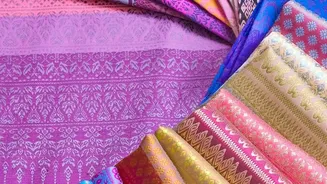
The vocabulary of Jamdani motifs is vast, drawing inspiration from nature and geometry. Traditional designs include 'butidar' (small scattered flowers), 'kalka' (paisley), and 'jalar' (net-like patterns). Weavers work without stencils, either from memory or a pattern drawn on graph paper placed beneath the loom, making each piece unique. A single saree can take weeks, months, or in highly intricate cases, even years to complete. Today, this ancient craft faces new challenges, from the competition of cheaper machine-made imitations to ensuring it provides a sustainable livelihood for artisans. In response, contemporary designers are collaborating with weavers, innovating with new materials like silk blends and modern silhouettes such as dresses and jackets, ensuring that Jamdani remains relevant for a new generation while preserving its priceless heritage.