








Meet 55 Cancri e: The Diamond Planet
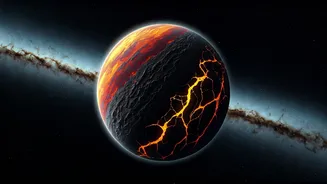
Located 41 light-years away, 55 Cancri e is a 'super-Earth'—a rocky planet nearly twice the width of our own world and about eight times as massive. It orbits its sun-like star so tightly that it completes a full circle in just 17 hours. This extreme
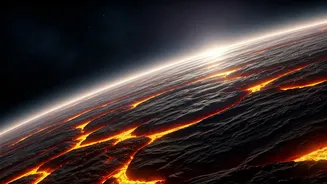
proximity has earned it the nickname 'hell planet'. Its surface temperature is estimated to be around 2,800 degrees Celsius, hot enough to melt rock and likely creating a global ocean of lava. Due to its density and composition, scientists have theorised that its interior could be rich in carbon, potentially compressed into a massive diamond. One side of the planet is thought to be permanently locked facing its star, leaving it in a state of eternal, scorching daylight.
The Mystery of the Missing Atmosphere
For years, scientists have debated whether a planet this hot and this close to its star could even hold onto an atmosphere. The intense radiation and stellar wind from its parent star should have stripped away any primordial gases long ago. Early observations were inconclusive, leaving a big question mark. Did 55 Cancri e have a substantial atmosphere, a thin veil of vaporised rock, or nothing at all? The puzzle was a crucial one, because understanding the line between a planet that can maintain an atmosphere and one that can't is key to our search for habitable worlds elsewhere.
Webb Telescope Makes a Breakthrough
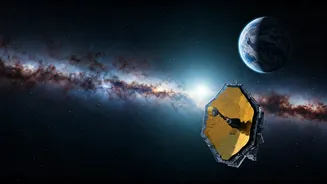
The game changed with the James Webb Space Telescope (JWST). Using its powerful infrared instruments, astronomers looked for signs of an atmosphere by analysing the planet's thermal emissions. They measured the temperature of the planet as it passed behind its star, a technique that allows them to isolate the light coming from the planet itself. The data revealed something surprising: the planet's dayside was hot, but hundreds of degrees cooler than expected if it were just a bare rock. This strongly suggested that an atmosphere was present, circulating heat from the scorching dayside to the cooler nightside.
An Atmosphere Born from Fire
The atmosphere detected by the JWST is not the planet's original one. Scientists believe it is a 'secondary' atmosphere, constantly being replenished by gases bubbling out from the magma ocean below. Think of it like a planetary-scale volcanic system, continuously feeding gases into the air. This outgassing process is believed to be releasing a mixture rich in carbon dioxide or carbon monoxide, which matches the light signatures observed by the telescope. This discovery marks the best evidence to date for a rocky planet outside our solar system having a substantial atmosphere, a major breakthrough in exoplanet science.
A Window into Earth's Fiery Past
While 55 Cancri e is far too hot for life, studying its bizarre environment provides a unique window into the early history of our own solar system. Planets like Earth, Venus, and Mars are also believed to have gone through a magma ocean phase billions of years ago. By observing a present-day example, scientists can test theories about how planets form and evolve. Understanding how 55 Cancri e's atmosphere is linked to its molten interior helps researchers model the processes that shaped rocky worlds, including our own. It's a rare chance to see the early stages of planetary evolution in action.