





The Most Dangerous Minute of a Launch
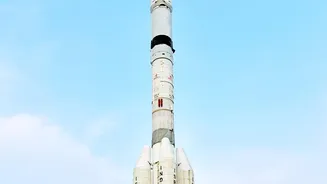
Imagine sticking your hand out of a car window on the highway; the force you feel is aerodynamic pressure. Now, imagine a rocket blasting through the atmosphere at supersonic speeds. This force becomes colossal. About 60 to 80 seconds into a launch, a rocket hits
a critical point called 'Max Q'. This is not a measure of speed or altitude alone, but the point of peak mechanical stress on the vehicle. It occurs at an altitude of around 11-14 km, where the combination of the rocket's increasing velocity and the still-dense air creates the maximum possible aerodynamic force. The air is literally pushing back with everything it has. For the rocket's structure, this is the moment of greatest strain, where any weakness could lead to catastrophic failure. To manage this, some rockets even throttle down their engines to reduce stress as they pass through this zone.
The Ultimate Escape Plan
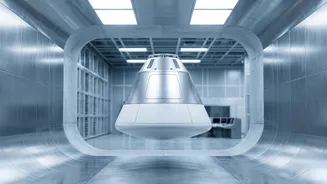
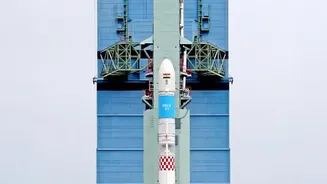
Human spaceflight missions are designed with a foundational belief: the crew must be able to escape a failing rocket at any point during launch. This is the job of the Crew Escape System (CES). For Gaganyaan, the CES is a tower-like structure fixed to the top of the crew module. It’s packed with powerful, fast-acting solid-fuel motors designed to do one thing: ignite in an instant and pull the crew module—and its astronauts—away from the exploding launch vehicle with immense force. This system is the astronauts' only lifeboat during the perilous ascent. ISRO has already conducted successful demonstrations of the CES, such as the TV-D1 test mission, which proved the system could function as intended during an in-flight abort scenario.
A Trial by Fire at Max Q
While aborting on the launch pad or at very high altitudes presents challenges, initiating an escape at Max Q is uniquely difficult. At this moment, the rocket is being battered by the most extreme aerodynamic forces of its entire flight. An abort sequence here means the escape motors must not only fight the rocket's own powerful upward thrust but also overcome the immense pressure trying to hold the capsule in place. The separation must be clean and instantaneous. If the capsule tumbles uncontrollably or fails to get clear of the disintegrating booster, the escape system would have failed. This specific scenario, sometimes simulated at a Mach number of 1.2, tests the CES under the worst possible aerodynamic conditions it would ever face. Successfully demonstrating an abort at Max Q proves that the escape system is robust enough to work when the physical stresses are at their absolute peak.
Building Confidence Through Rigorous Testing
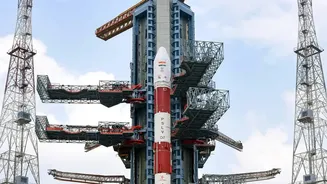
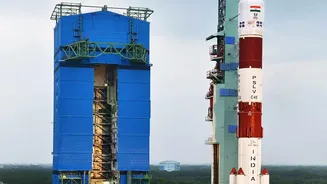
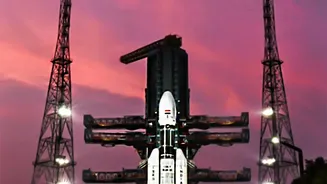
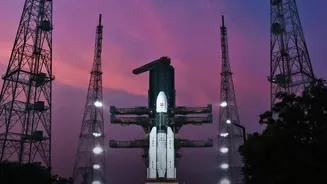
For ISRO, testing the abort capabilities under these extreme conditions is not just a technical requirement; it's a fundamental part of building a safe and reliable human spaceflight program. Each test, from pad aborts to high-altitude escapes, validates different aspects of the system. The TV-D1 mission, for example, successfully tested an abort at a high altitude, validating the sequence of parachute deployments and capsule recovery. A Max Q abort test would be the next logical and most challenging step, pushing the system's design to its limits. These uncrewed tests are performed using a dedicated Test Vehicle, designed to simulate the flight conditions of the much larger, human-rated LVM3 rocket. Every successful test provides crucial data and builds confidence among engineers, flight controllers, and most importantly, the astronauts who will entrust their lives to this technology.
What It Means for India's Space Dream
The Gaganyaan program is more than a technological demonstration; it's a national ambition to become the fourth country capable of independent human spaceflight. The lives of the 'Gaganauts' are the highest priority. Proving that the Crew Escape System can function flawlessly during the most violent and stressful moment of a launch is a non-negotiable milestone on the path to the first crewed flight, targeted for 2027. These rigorous safety tests are what separate an experimental rocket from a human-rated launch system. By methodically and transparently testing every failure scenario, ISRO is not just building a spacecraft; it is earning the trust required to safely carry Indian citizens into orbit and bring them home. Each successful test, especially one as demanding as a Max Q abort, brings that national dream one giant leap closer to reality.