





The Limits of Radio Waves
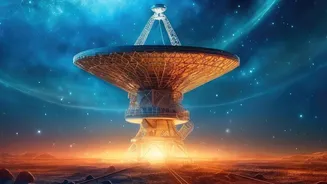
For decades, our connection to spacecraft exploring the solar system has relied on radio waves. NASA's Deep Space Network (DSN) is a global system of massive antennas that has faithfully served missions from Voyager to the Mars rovers. However, radio frequency
(RF) communications are nearing their bandwidth limit. As missions become more sophisticated, they generate enormous volumes of data, including high-resolution imagery that takes hours to transmit. Sending humans to Mars will require live video feeds and real-time data streams that current radio systems simply cannot support efficiently. The need for a faster, more robust communication method has become critical for the next era of space exploration.
A Breakthrough in a Beam of Light
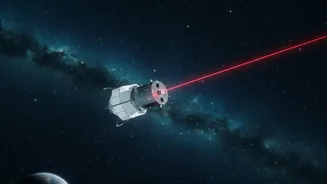
The solution is a monumental leap in technology: Deep Space Optical Communications, or DSOC. Instead of radio waves, DSOC uses near-infrared laser light to transmit information. Think of it as upgrading from old telephone lines to fiber optics, but on a cosmic scale. This technology promises data rates 10 to 100 times higher than the best radio systems, without increasing the mass or power requirements on the spacecraft. This means future missions can send back more science, clearer images, and even stream HD video, fundamentally changing how we explore the cosmos.
How It Works: A Cosmic Game of Catch
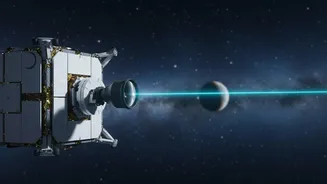
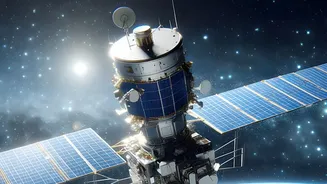
The process is a stunning feat of precision engineering. A cutting-edge instrument called a flight laser transceiver, hitching a ride on NASA's Psyche spacecraft, is at the heart of the system. To start a communication link, a powerful laser beacon is transmitted from a ground station on Earth, like the one at JPL's Table Mountain facility in California. The transceiver aboard Psyche, which could be millions of kilometers away, must then detect this faint beam and lock onto it. Once locked, the transceiver encodes data—like an HD video—onto its own near-infrared laser and beams it back to Earth. The beam is incredibly narrow, so the pointing accuracy required is immense, akin to hitting a moving target the size of a coin from kilometers away.
Receiving the Signal on Earth
Catching this faint signal back on Earth requires a powerful receiver. The primary downlink station is the famous 200-inch Hale Telescope at Caltech's Palomar Observatory in California. The telescope is equipped with a highly sensitive instrument that can count individual photons—the quantum particles of light—that make up the laser beam. This superconducting nanowire photon-counting receiver is crucial for decoding the data sent from the spacecraft, even after the laser signal has weakened significantly over its vast journey. After the Hale Telescope downloads the signal, the decoded video frames can be sent to NASA's Jet Propulsion Laboratory (JPL) and played in real time.
Putting the Technology to the Test
The DSOC experiment has been a resounding success. In a landmark test, it streamed a 15-second, pre-loaded HD video of a cat named Taters from 31 million kilometers away. The video was transmitted at a rate of 267 megabits per second (Mbps), comparable to broadband internet speeds. As the Psyche spacecraft has traveled further, the system has continued to set records, successfully transmitting data from distances greater than that between Earth and Mars. Even at 226 million kilometers, it achieved a data rate of 25 Mbps, far surpassing what's possible with traditional radio. The demonstration has now successfully completed its final tests, proving its viability for future missions.
The Future Is an Interplanetary Internet
The success of DSOC marks the beginning of a new chapter for space communication. This technology is not just about faster downloads; it is the foundational infrastructure for an interplanetary internet. It will allow for high-bandwidth science from the farthest reaches of our solar system and provide the reliable, high-speed communication links necessary to support human crews on Mars. By enabling astronauts to stream HD video back to Earth and receive complex information in real time, laser communications will make deep space feel a little bit closer to home, empowering the next giant leap for humanity.