




A Steamy Discovery in a Planet Nursery
In a remarkable finding, astronomers using the James Webb Space Telescope (JWST) have detected water vapour within the inner disk of a young star system called PDS 70, located 370 light-years away. This isn't just any water detection; it's the first time
water has been found in the terrestrial, rocky-planet-forming zone of a system already known to host planets. Think of it as finding a water source right where a new house is being built. According to scientists, previous telescopes couldn't make this kind of measurement. The discovery is profoundly exciting because it confirms that the essential ingredients for life as we know it are available at the very beginning of a rocky planet's formation. The raw materials, like silicates and water, are all present in this cosmic construction site.
The Telescope’s Technological Marvel
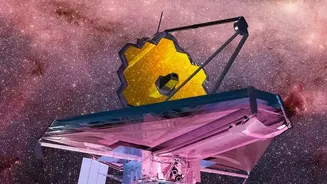
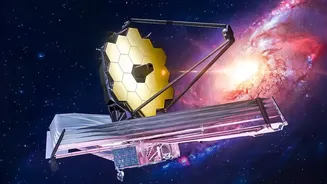
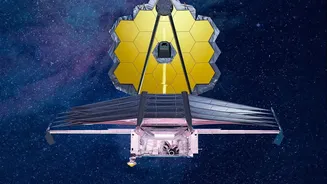
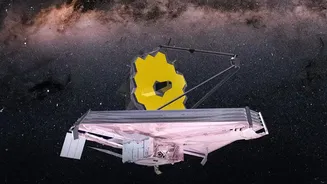
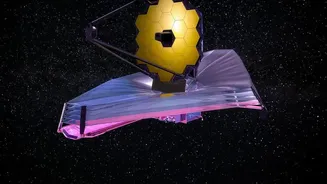
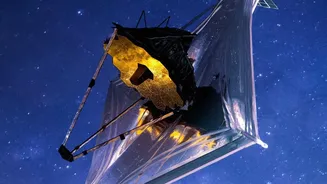
So, how did Webb achieve this? The secret lies in its specialised infrared instruments, particularly the Mid-Infrared Instrument (MIRI) and the Near-Infrared Spectrograph (NIRSpec). These tools allow the telescope to see in infrared light, a spectrum invisible to the human eye. This capability is crucial because it allows Webb to peer through the thick dust that often shrouds nascent planetary systems. More importantly, infrared light is perfect for analysing the chemical makeup of gases. The detection in the PDS 70 system was made by the MIRI instrument, which is specifically designed to pick up the faint heat signatures of molecules in these distant environments. This technological power is what separates JWST from its predecessors like Hubble, giving it the ability to deliver more detailed and unambiguous results.
Reading a Chemical Fingerprint
The phrase "spectral lines" sounds complex, but the idea behind it is quite elegant. This technique, called transmission spectroscopy, involves analysing the light from a star as it passes through a planet's atmosphere or a protoplanetary disk. As the starlight filters through the gas and dust, different molecules absorb very specific colours, or wavelengths, of that light. This process leaves behind a pattern of dark lines in the light's spectrum, much like a barcode. Each molecule has a unique and unmistakable barcode, or 'fingerprint'. For the PDS 70 system, JWST's instruments detected the clear, distinct spectral signature of water. This is what makes the finding so definitive; it's not a guess, but a direct reading of the chemical composition from hundreds of light-years away.
Beyond Just Finding Water
While finding water is a massive milestone, the power of JWST’s instruments goes much further. The same spectroscopic method can identify a host of other important molecules, including methane, carbon dioxide, and carbon monoxide. In another recent discovery, Webb detected both methane and water vapour in the atmosphere of the exoplanet WASP-80 b. The ability to detect a range of chemicals is vital. It's not just the presence of water that might indicate habitability, but the specific ratio of different elements and compounds. These chemical mixes can offer clues about a planet’s geology, its atmospheric processes, and potentially even the presence of biological activity, so-called biosignatures. Each detection serves as a crucial piece of the puzzle.
The Search Enters a New Era
These findings are more than just isolated discoveries; they represent a new era in the search for life beyond Earth. Each observation serves as a successful test of JWST’s incredible capabilities, proving that the technology works as designed. Having confirmed it can find water in a planet-forming disk, astronomers will now turn Webb's golden eye toward other promising targets, especially rocky exoplanets orbiting within the 'habitable zone' of their stars—the region where liquid water could exist on a planet's surface. While challenges like cloud cover can make detection difficult, the precision of Webb's instruments marks a giant leap forward. The telescope is systematically moving planetary science from theory to hard data, bringing us closer than ever to answering one of humanity’s oldest and most profound questions.