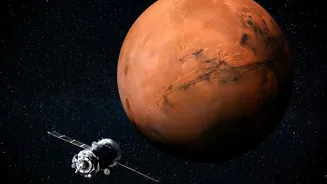



Landing on another world is one of humanity's greatest achievements. But while the Moon landings are iconic, setting a spacecraft down on Mars is an entirely different and more perilous challenge that has tested engineers for decades.
The Atmosphere Problem
The single biggest
difference is the atmosphere. The Moon has virtually no atmosphere, which is a straightforward physics problem: you just use retro-rockets to slow your descent. Mars, however, is deceptively difficult. Its atmosphere is about 100 times thinner than Earth's, making it the worst of both worlds. It is thick enough to generate immense heat and friction as a spacecraft enters at high speed, requiring a robust heat shield. Yet, it is far too thin to slow a heavy lander down sufficiently with just parachutes. This means a multi-stage approach is necessary, combining a heat shield, supersonic parachutes, and powered descent engines, creating a complex sequence where much can go wrong.
The Tyranny of Distance and Time
The Moon is our celestial neighbour, just a few days away. Mars is a vast distance across the solar system, requiring a journey of at least seven months. This enormous gap has two major consequences. First, the launch window to Mars only opens every 26 months when the planets are favourably aligned, making mission timing critical. A mission to the Moon can be launched almost any month. Second, and more critically for landing, is the communication delay. A radio signal takes about 1.3 seconds to travel from Earth to the Moon, allowing for near-real-time communication. For Mars, that one-way delay can be up to 22 minutes. This makes direct human control of a landing impossible.
The ‘Seven Minutes of Terror’
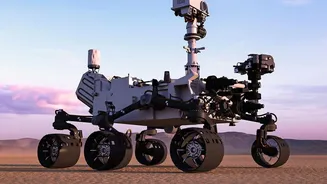
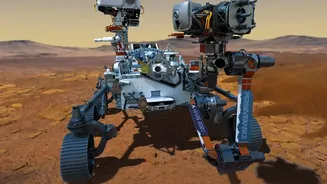
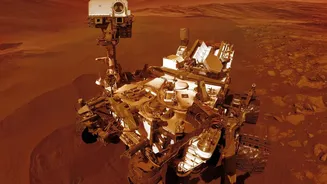
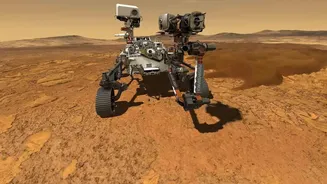
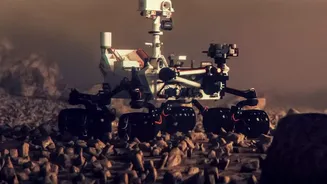
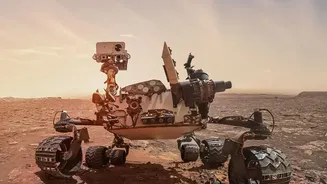
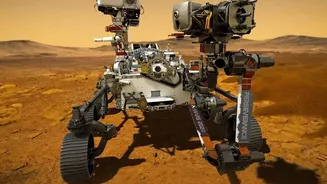
Because of the communication delay, a Mars landing must be completely autonomous. This nail-biting, pre-programmed sequence is famously known at NASA as the 'seven minutes of terror'. During this time, the spacecraft must perform a perfect series of manoeuvres—from atmospheric entry at 20,000 km/h to deploying a parachute, firing rockets, and, for rovers like Curiosity and Perseverance, executing a complex 'sky crane' manoeuvre that lowers the vehicle to the surface on cables. Mission controllers on Earth can only watch and wait. By the time they receive the signal that the entry has begun, the rover has already been on the surface—either safely or in pieces—for several minutes.
Gravity and Landing Systems
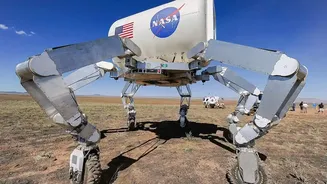
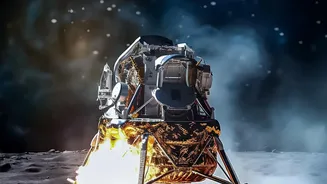
Mars has more than double the surface gravity of the Moon—about 38% of Earth's gravity compared to the Moon's 16%. This stronger pull means a landing spacecraft has more momentum and requires significantly more thrust to slow down and achieve a soft landing. This, combined with the thin atmosphere, makes designing landers much harder. The Apollo lunar modules were light and didn't need to be aerodynamic. Mars landers must be heavier to carry the necessary fuel and equipment for a more powerful, guided descent, and their design must account for both aerodynamic forces and a final propulsive landing stage.
Weather and Surface Hazards
The Moon is a static, weatherless environment. Its surface is well-mapped and predictable. Mars, on the other hand, has weather, including giant dust storms that can last for weeks and cover the entire planet. These storms can block sunlight, affecting solar-powered rovers, and the atmospheric dust poses a risk to mechanical systems. The Martian terrain is also more varied and potentially hazardous, with rocks, craters, and slopes that make selecting a safe landing site a challenge in itself and require advanced autonomous navigation systems like Terrain-Relative Navigation.