



The Allure of the Edge of Space
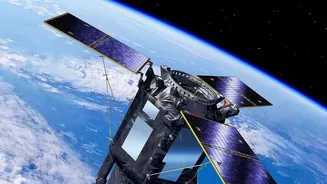
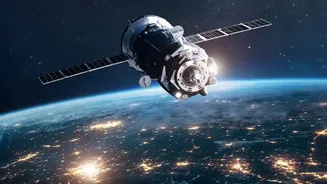
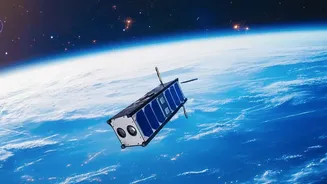
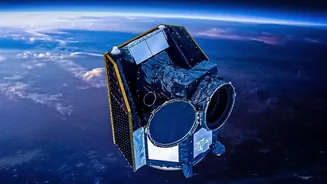
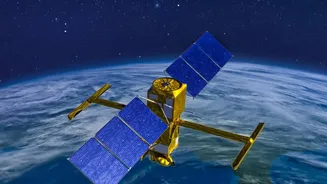
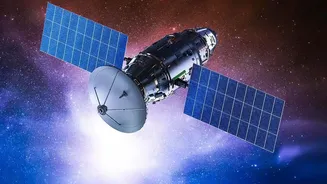
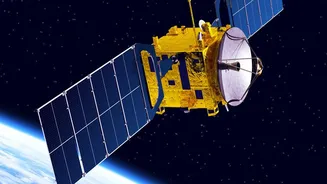
Very Low-Earth Orbit, or VLEO, is the region of space roughly 150 to 450 kilometres above our heads. It's a highly desirable location for the next generation of satellites. Being so close to the Earth's surface means satellites can capture incredibly
high-resolution images, provide faster communication with lower signal delay, and gather more detailed atmospheric data. For applications ranging from climate monitoring and disaster management to global high-speed internet, VLEO offers significant advantages over the more crowded higher orbits. The market for VLEO satellites is projected to grow exponentially, highlighting its importance for future space-based infrastructure.
The Problem with Flying Low
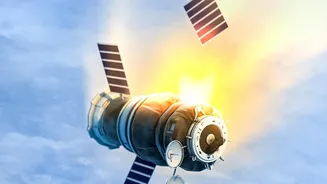
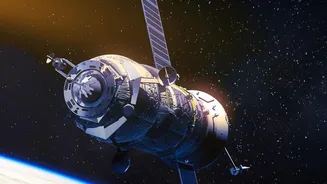
The biggest challenge of operating in VLEO is atmospheric drag. While the air is incredibly thin at these altitudes, it's still dense enough to act like a brake on fast-moving satellites. This constant friction causes their orbits to decay, meaning they gradually lose altitude and fall back to Earth unless they constantly fire their thrusters to stay in position. This requires a significant amount of on-board propellant. Consequently, the operational lifespan of a VLEO satellite is often severely limited by how much fuel it can carry, turning potentially long-term missions into short-lived, expensive ventures. Furthermore, the atmosphere in this region contains atomic oxygen, which can corrode satellite surfaces over time.
A 'Perpetual Motion' Engine for Space
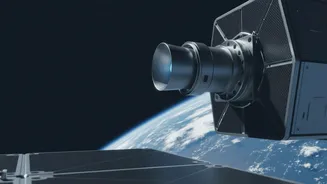
The breakthrough is a technology called air-breathing electric propulsion (ABEP), also known as air-scooping electric propulsion (ASEP). Instead of carrying heavy tanks of propellant like xenon gas, these systems are designed to 'breathe' in the residual atmosphere. An innovative intake collector scoops up the sparse air molecules—mostly nitrogen and oxygen—which are then ionized (given an electric charge) and accelerated by an electric field to create thrust. This thrust is designed to precisely counteract the atmospheric drag, allowing a satellite to maintain its orbit indefinitely without using any stored fuel. It essentially allows the satellite to live off the land, turning the very thing that hinders it—the atmosphere—into its source of fuel.
From Theory to Reality
First proposed decades ago, air-breathing propulsion is now on the cusp of becoming operational, thanks to significant research by organisations like the European Space Agency (ESA) and various companies funded by agencies such as DARPA in the US. On-ground tests have successfully demonstrated that the concept is feasible, proving that incoming air can be captured and used to generate thrust. Multiple companies, including US-based Phase Four and CU Aerospace and India-based Orbitt Space, are actively developing these systems, with some projects aiming for on-orbit demonstrations within the next few years. These developments are transforming ABEP from a theoretical concept into a tangible technology poised to redefine satellite capabilities.
Unlocking Decades of VLEO Operations
By eliminating the need for on-board propellant to counteract drag, this technology could extend the mission lifetime of VLEO satellites from just months to many years, potentially even decades. This dramatically changes the economic equation for operating in this valuable orbit. Satellites for Earth observation could provide persistent, ultra-high-resolution monitoring of specific locations for unprecedented lengths of time. Communication constellations could offer more reliable, low-latency services without the need for frequent satellite replacements. The VLEO region, currently a challenging frontier, would become a sustainable and commercially viable environment for a new generation of long-duration missions, from scientific research to advanced intelligence gathering.