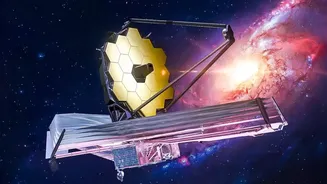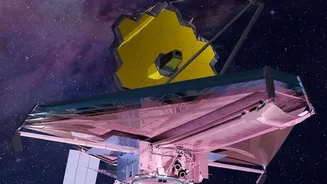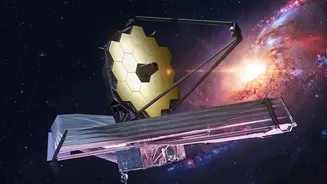





The James Webb Space Telescope (JWST) continues to peer back to the dawn of time, and its latest find is a stunner: two gigantic, brilliantly lit quasars nestled together just 900 million years after the Big Bang. This cosmic duo is forcing a rethink.
First, What Is a Quasar?
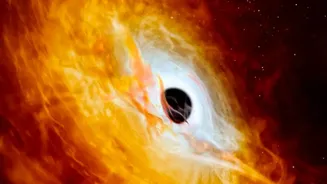
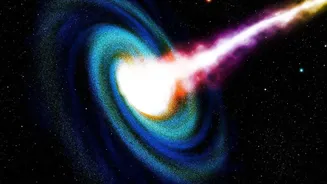
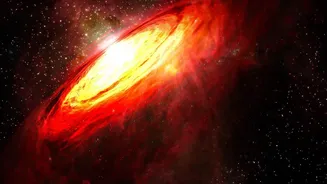
Before diving into the discovery, it helps to know what we are looking at. A quasar, short for 'quasi-stellar object', is not a star, but the intensely luminous core of a very distant, active galaxy. At the heart of this galaxy is a supermassive black hole that is actively feeding on enormous amounts of gas and dust. As this material spirals into the black hole, it forms a superheated accretion disk. The friction and gravitational forces are so extreme that the disk shines with more light than thousands of Milky Way-sized galaxies combined, making quasars some of the brightest objects in the universe.
A Pair of Giants at Cosmic Dawn
Astronomers using data from a JWST survey called Aether spotted something unusual about a known quasar: it seemed to have a companion. Follow-up observations with the powerful Gemini North telescope in Hawai'i confirmed their suspicions. They had found a pair of quasars, designated J1602+4228AB and given the Hawaiian nickname Nāpōwawāʻenakaulua. What makes this pair, seen as they were just 900 million years after the Big Bang, so extraordinary are their masses and proximity. One black hole is estimated to be 1.5 billion times the mass of our sun, while its partner weighs in at a still-staggering 400 million solar masses. They are separated by only 18,100 light-years, a cosmic stone's throw and roughly one-fifth the diameter of our own galaxy.
Why This Discovery Is a Big Deal
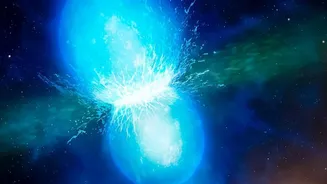
Finding one supermassive black hole this early in the universe's history, a period known as 'cosmic dawn,' is already a puzzle for astronomers. Current models suggest that black holes need much more time, at least a billion years, to grow to such immense sizes through mergers and feeding. The JWST has been consistently finding these massive objects earlier than expected, but finding a pair of them this close together adds a whole new layer of complexity. The presence of two such giants suggests they are in the process of a galactic merger, a chaotic dance that provides the fuel needed to light up both quasars. This discovery provides a rare, direct snapshot of this fundamental process of galaxy assembly happening in the universe's infancy.
A Laboratory in the Early Universe
This quasar pair is more than just a record-holder; it's a unique natural laboratory for studying cosmic evolution. Astronomers theorize that pairs of quasars should be more common in the early, crowded universe, but they are incredibly difficult to spot. They are rare, their active phase is short, and at such vast distances, resolving two distinct objects so close together is a major technical challenge. The discovery of Nāpōwawāʻenakaulua suggests that it exists in an exceptionally dense knot of the cosmic web, a region rich in the raw materials for building galaxies and black holes at an accelerated rate. This environment would encourage frequent galactic interactions, intense bursts of star formation, and the rapid growth of the black holes at their centers.