
Secrets of the Sun’s Fiery Crown
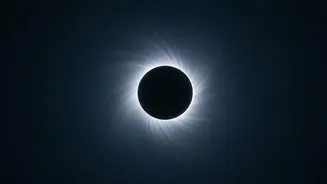
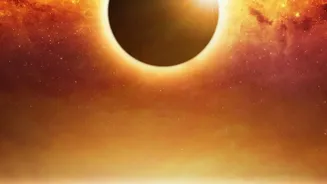
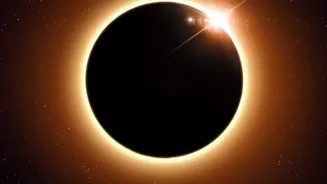
The most sought-after prize during an eclipse is a clear view of the solar corona, the sun's wispy, superheated outer atmosphere. Normally, the sun's blindingly bright surface, or photosphere, makes the corona impossible to see. It’s about a million times
dimmer than the sun's disk. During totality, the moon acts as a perfect natural shield, revealing the corona's intricate streamers and loops. Scientists use this rare opportunity to tackle one of solar physics' biggest mysteries: the coronal heating problem. While the sun's surface simmers at around 6,000 degrees Celsius, the corona reaches temperatures of over a million degrees. Understanding why the atmosphere is so much hotter than the surface is key to understanding the sun itself. Eclipses provide an unparalleled chance to observe the region closest to the sun's surface, where this mysterious heating process is thought to originate.
A Fleeting Look at Space Weather
Observing the corona isn't just about solving temperature puzzles. It’s also crucial for understanding space weather—the stream of charged particles and radiation, known as the solar wind, that constantly flows from the sun. These solar winds can trigger powerful geomagnetic storms that disrupt satellites, power grids, and communication systems on Earth. During an eclipse, scientists can directly observe how the solar wind is accelerated and how coronal mass ejections, or CMEs, are launched from the sun. These observations help improve models that predict space weather, giving us a better chance to prepare for potentially damaging solar events. While scientists have instruments called coronagraphs to mimic eclipses, these artificial disks struggle to see the innermost part of the corona, a critical region for these phenomena. A natural eclipse provides the clearest, most complete view.
A Ripple in Our Atmosphere
A solar eclipse doesn't just affect the sun; it has a profound and immediate impact on Earth. As the moon’s shadow sweeps across the planet, it temporarily blocks the sun's extreme ultraviolet radiation. This radiation is responsible for creating the ionosphere, an electrically charged layer of our upper atmosphere that stretches from about 80 to 640 kilometres up. The ionosphere is vital for radio communications, as it reflects signals over long distances. When the solar radiation is suddenly switched off, the ionosphere essentially relaxes, shifting from daytime to nighttime conditions in minutes. Researchers use this natural experiment to study how the ionosphere forms, changes, and recovers. By measuring these rapid changes in density and temperature, scientists can refine their understanding of this critical atmospheric layer, which is crucial for GPS accuracy and radio communications.
When Nature Gets Confused
It’s not just instruments that are busy during an eclipse; biologists and citizen scientists are watching the animal kingdom closely. The sudden darkness and drop in temperature can confuse wildlife, which relies on the sun as a cue for daily behaviour. During past eclipses, observers have noted birds falling silent and returning to their nests, bees stopping their buzzing, and even some spiders starting to dismantle their webs as if night has fallen. Conversely, nocturnal animals like crickets and frogs might start their evening calls, only to be silenced again when the sun returns. While pets like dogs and cats are less likely to have a strong reaction, the unusual event can cause confusion or anxiety. These observations help scientists understand how deeply ingrained circadian rhythms are and how animals respond to unexpected environmental changes.
Testing the Fabric of the Universe
Historically, eclipses have been platforms for some of science's most groundbreaking discoveries. In 1919, an expedition led by Sir Arthur Eddington used a total solar eclipse to provide one of the first observational proofs of Albert Einstein's theory of general relativity. The theory predicted that gravity from a massive object—like the sun—could bend the path of light. By measuring the apparent position of stars near the sun during totality, Eddington confirmed that their light was indeed being bent, just as Einstein had predicted. While this theory is now well-established, scientists still use the unique conditions of an eclipse to conduct novel experiments, from searching for small asteroids orbiting close to the sun to taking more accurate thermal readings of planets like Mercury.