






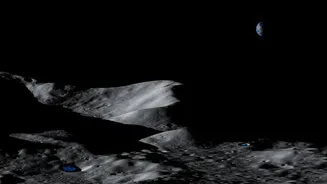
The Vision: An Artemis Base Camp
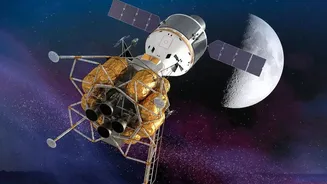
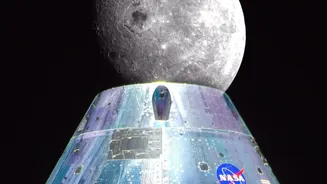
For the first time since the Apollo era, humanity is planning a long-term stay on the Moon. The goal of NASA's Artemis program is to establish a sustained human presence at the lunar South Pole, a region thought to be rich in resources like water ice.
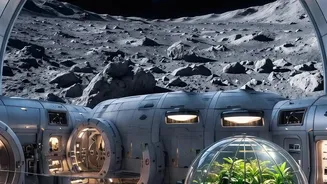
This 'Artemis Base Camp' won't be a single structure but an evolving outpost. Plans include a surface habitat, unpressurised and pressurised rovers for exploration, power systems, and facilities to use local materials—a concept known as In-Situ Resource Utilisation (ISRU). Before astronauts can move in for stays lasting up to two months, NASA needs to answer some fundamental questions about how to survive and thrive in the harsh lunar environment.
Science First to Ensure Survival
Building a lunar outpost isn't just an engineering problem; it's a scientific one. Future astronauts will face extreme temperatures, harmful radiation, and the constant threat of micrometeorite impacts. To prepare, NASA is deploying a series of robotic missions and experiments to scout ahead. Through its Commercial Lunar Payload Services (CLPS) initiative, the agency is sending suites of instruments to the surface to act as a vanguard for human explorers. These investigations, selected under the Payloads and Research Investigations on the Surface of the Moon (PRISM) program, are designed to create an interplanetary survival guide, gathering vital data on hazards and resources before crews arrive.
Hunting for Shelter in Lava Tubes
One of the most exciting investigations is the search for natural shelters. The GIMLI (Geophysical Instruments for Marius Lunar pit Investigation) payload is tasked with exploring a feature known as the Marius Hills Pit. Scientists believe this pit could be a 'skylight'—an opening to a vast, underground lava tube. Such a subterranean cave could offer astronauts a ready-made shelter, providing natural protection from the extreme temperature swings and dangerous radiation on the surface. The GIMLI instruments will scan beneath the ground to confirm if the pit connects to a larger tube system, potentially identifying prime real estate for a future protected habitat.
Monitoring the Hostile Environment
To live on the Moon, we need to understand its daily rhythms and dangers. The Lunar Environment Monitoring Station (LEMS) will act as a long-duration weather station for the Moon. This autonomous suite of instruments will use a seismometer to detect 'moonquakes' and micrometeorite strikes, providing a real-time assessment of geologic hazards. It will also monitor the thin lunar atmosphere for volatiles—materials like water that can turn to gas—helping scientists understand their movement and concentration across the surface. This data is crucial for designing hardware and planning astronaut activities safely.
Finding and Using Lunar Ice
Perhaps the most critical resource for a future base is water ice, which is believed to be trapped in permanently shadowed craters at the South Pole. Water can be used for drinking, growing plants, creating breathable oxygen, and even being split into hydrogen and oxygen for rocket fuel. The Distribution of Ice and Surface Characteristics Observatory (DISCO) payload is designed to get the first direct, on-the-ground measurements of this ice. DISCO will not only pinpoint where ice is and how much is there but also study the stability of the terrain for rovers and the effect of rocket exhaust on the surface. This information is essential for developing the technology to turn lunar ice into usable resources for the base camp.