




Water, Water Everywhere?
Water is surprisingly common in the universe. We see its signature not just on Earth, but in the icy rings of Saturn, on the moons of Jupiter, and even in the atmospheres of planets orbiting other stars. The long-standing theory has been that water primarily
forms as ice on tiny dust grains in frigid, dense interstellar clouds. Over millions of years, as these clouds collapse to form new stars and planets, that ice gets incorporated into the system. Think of it as a cosmic delivery service: water molecules are born in the cold depths of space and then shipped to new planetary systems, eventually arriving on comets and asteroids or getting mixed into the planets themselves. This model neatly explained how a rocky planet like Earth, which formed in a hot region of our solar system where water should have boiled away, ended up with vast oceans. The water, scientists believed, was delivered later from the colder, outer solar system.
A Surprise in the Clouds
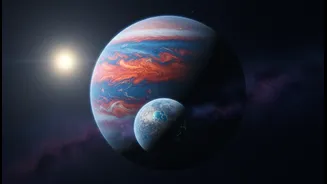
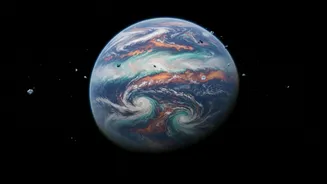
The James Webb Space Telescope (JWST) has given us an unprecedented ability to peer into the atmospheres of these distant worlds, and it's finding some things that don't quite fit the old story. Recently, astronomers have detected the chemical signature of water vapour in the atmospheres of several gas giants—massive planets like Jupiter. One notable example is WASP-18 b, a gas giant ten times more massive than Jupiter. It orbits so close to its star that its atmosphere sizzles at nearly 2,700 degrees Celsius. At those temperatures, most water molecules should be torn apart, yet Webb’s sensitive instruments still picked up their distinct signature. The mere presence of water in such an extreme environment is remarkable. But finding it on these giant planets, which are thought to form differently and in different locations than rocky worlds, is what truly complicates the picture.
Rewriting the Cosmic Water Cycle
So why does finding water on a hot gas giant matter so much? It challenges the simple 'delivery' model. Gas giants are thought to form very quickly, gobbling up huge amounts of gas and dust from the early protoplanetary disk. If they contain significant amounts of water, it suggests that water was readily available as a gas in the hot, inner parts of these young solar systems, not just locked away as ice in the cold outer regions. This implies that water might not just be passively inherited from interstellar clouds, but could also be actively formed or preserved under conditions scientists didn't think possible. Some models now suggest that water might be a natural byproduct of the planet formation process itself, created through chemical reactions in the hot magma oceans of young worlds. Other studies indicate that the atmospheres we see might only be the tip of the iceberg, with vast reservoirs of hidden water deeper inside these planets, which could mean our telescopes are underestimating how much water is truly there.
What This Means for the Future
This evolving understanding has huge implications. If water is more resilient and can form in more diverse ways than we thought, then the number of potentially habitable worlds in the galaxy could be far greater. The interstellar water cycle appears to be less of a simple, linear journey from ice cloud to ocean, and more of a complex, dynamic system with multiple pathways for water to form and distribute itself. The discovery also refines our search for life. Instead of just looking for water on Earth-like rocky planets, astronomers now have more reason to study the full diversity of planets out there. Each detection of water, whether on a scorching gas giant or a distant rocky world, provides another crucial clue in the grand puzzle of where water—and life—comes from. These gas giants, once seen mainly as disruptors in planetary systems, are now revealing themselves as key storytellers in the cosmic history of water.