


A Journey Across 150 Million Kilometres
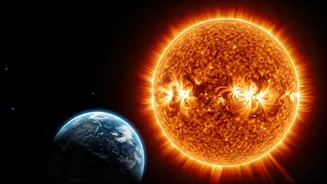
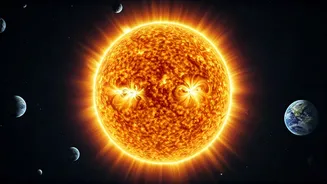
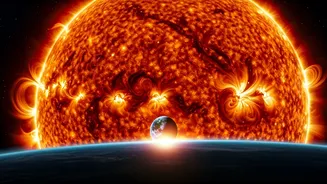
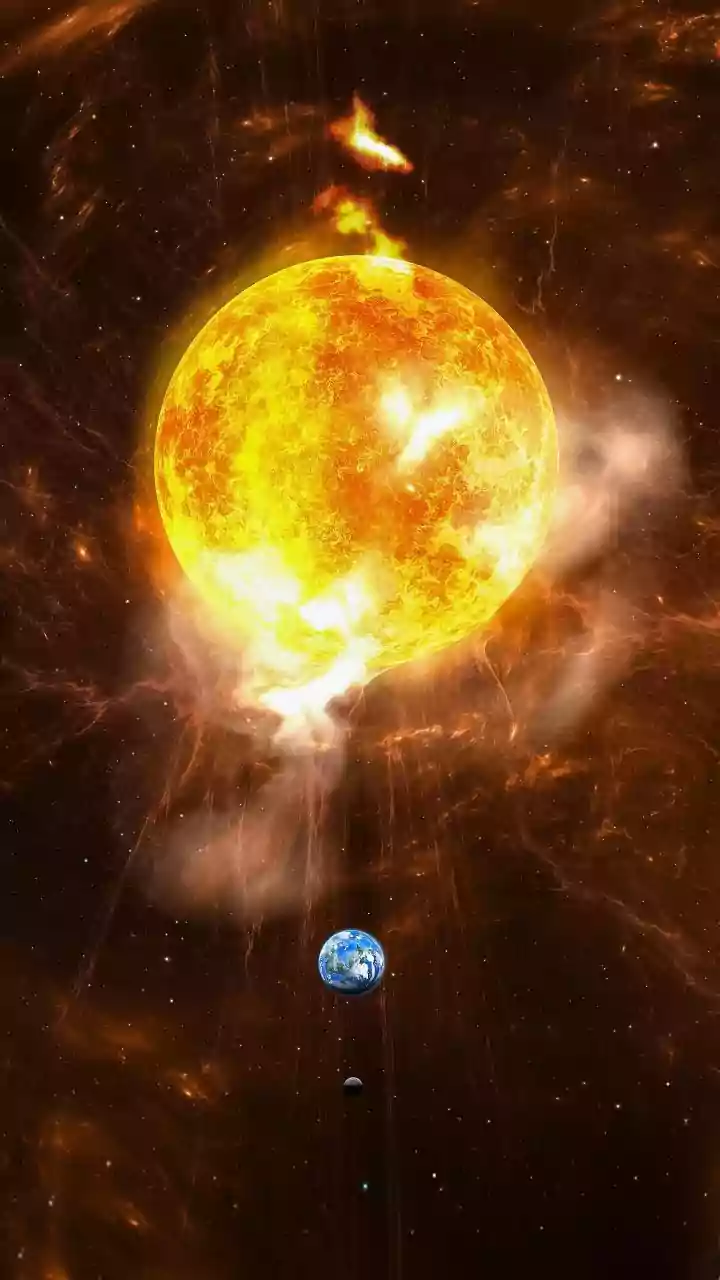
It’s a fact that sounds like science fiction, but it’s based on simple cosmic mathematics. The Sun is, on average, about 150 million kilometres away from Earth. Light, while incredibly fast, is not instantaneous. It travels at a constant, finite speed:
approximately 300,000 kilometres per second. This is the universe's ultimate speed limit; nothing can travel faster. When you do the maths (150,000,000 km divided by 300,000 km/s), you get 500 seconds. Convert that to minutes, and you arrive at roughly 8 minutes and 20 seconds. So, every time you step outside and feel the sun’s warmth, you are experiencing energy that left the surface of our star more than eight minutes ago. You are, in a very real sense, basking in the past.
The Cosmic Speed Limit in Action
To put the speed of light into perspective, a photon of light could circle the Earth's equator more than seven times in a single second. It feels instantaneous to us in our daily lives. When you flip a light switch, the room illuminates immediately. But over the vast distances of space, this finite speed becomes noticeable.
Imagine trying to cover that 150-million-kilometre gap by other means. A commercial jet flying at a steady 900 km/h would take over 19 years to complete the journey. Even our fastest space probes would take months. Light, the undisputed champion of cosmic speed, makes this journey in the time it might take you to make a cup of chai or listen to a couple of songs. This delay isn't a glitch; it's a fundamental property of our universe.
What if the Sun Vanished?
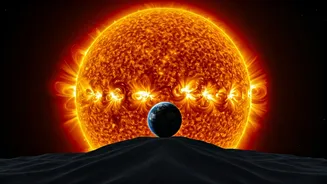
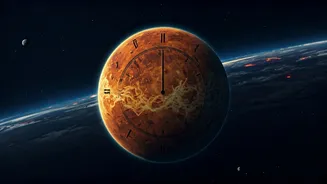
This eight-minute delay has a profound and slightly unsettling implication. If the Sun were to suddenly disappear—an impossible event, but a useful thought experiment—we wouldn't know it for 8 minutes and 20 seconds. For that duration, Earth would continue to orbit a ghost, and we would still see the Sun in our sky and feel its warmth. Only after the last photon from its final moment completed its journey would darkness fall and gravity release its hold. It’s a powerful reminder that our perception of the universe is always slightly out of date.
You Are Always Looking at the Past
This principle extends far beyond our own star. Every point of light you see in the night sky is a window into the past. The closest star system to us, Alpha Centauri, is about 4.2 light-years away. This means the light we see from it tonight left that star 4.2 years ago. When we gaze at the Andromeda Galaxy, the nearest major galaxy to our own, we are seeing it as it was 2.5 million years ago, long before modern humans existed.
The sunlight on your skin is just the beginning of this cosmic time-travel. It’s the most immediate and personal connection we have to the fact that the universe doesn’t unfold in real-time for us. We are always observing echoes of events that have already happened, from eight minutes ago to millions of years in the past.
The Photon's Incredible Inner Journey
While the eight-minute trip from the Sun's surface to your skin is impressive, the journey of that light *before* it even left the star is even more mind-boggling. The photons (particles of light) that make up sunlight are created through nuclear fusion in the Sun's core. The core is so incredibly dense that a newly created photon can't travel in a straight line. Instead, it gets absorbed and re-emitted by atoms countless times, bouncing around in a chaotic 'random walk.' This process can take tens of thousands, or even hundreds of thousands, of years. So, the sunlight warming you today was technically created in the Sun's core during Earth's last ice age. After that long, tortuous escape, its final eight-minute sprint to Earth seems like a victory lap.