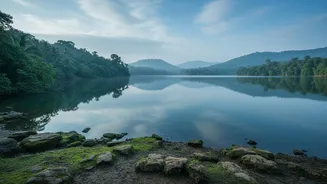








A Lake's Memory
In the Korba district of Chhattisgarh, the Raja Rani Lake appears placid and unassuming. But for scientists from the Birbal Sahni Institute of Palaeosciences (BSIP) in Lucknow, it is a time capsule. By drilling down and extracting a 40-centimetre sediment
core, they have been able to peer deep into the past. As layers of mud settle in a lakebed over centuries, they trap organic materials from the surrounding environment. Among the most resilient of these are pollen grains. Thanks to an incredibly tough outer wall, pollen can survive for millennia, preserving a perfect fingerprint of the plant life that existed when each layer of sediment was formed. This field of study, known as palynology, allows researchers to reconstruct ancient landscapes and, by extension, the climatic conditions that supported them.
Reconstructing an Ancient Forest
By meticulously identifying and counting the pollen grains at different depths of the core, the researchers were able to build a vegetative history of the region. The findings, which cover the last 2,500 years, tell a story of significant environmental change. The analysis revealed a shift from savannah-like grasslands to wooded savannahs, and eventually to dense, mixed tropical deciduous forests. This transformation points to a substantial increase in moisture. The evidence for a lush forest ecosystem was particularly strong during a period known as the Medieval Climate Anomaly, which occurred roughly between 1060 and 1725 CE. During this time, the dominance of pollen from forest-loving plants indicates a warm, humid climate sustained by a powerful Indian Summer Monsoon (ISM).
A Stronger, Wetter Monsoon
The key takeaway from the study is that the Indian Summer Monsoon during this medieval period was significantly stronger than previously understood. The Raja Rani Lake is situated in India's Core Monsoon Zone (CMZ), a region that receives the vast majority of the country's annual rainfall and is highly sensitive to monsoon fluctuations. The pollen record from this critical zone showed no evidence of major dry spells during the Medieval Climate Anomaly, suggesting a consistently intense monsoon season for centuries. Scientists believe this powerful monsoon was driven by a combination of global factors, including La Niña-like conditions in the Pacific Ocean and increased solar activity, which influenced large-scale atmospheric patterns.
Why Ancient Clues Matter Today
Understanding what the monsoon did a thousand years ago is more than just a historical curiosity. This type of research provides what is known as 'proxy data'—physical evidence from the past that can stand in for direct weather measurements. This historical data is invaluable for testing and refining the climate models we use to predict the future. By inputting data from past warm periods, scientists can better understand how regional climates, particularly the notoriously complex Indian Summer Monsoon, might respond to rising global temperatures today. For a country as dependent on the monsoon for agriculture, water security, and its overall economy, more accurate predictions are not just an academic exercise; they are a critical tool for future planning and resilience. The ancient pollen of Chhattisgarh provides a vital lesson: nature keeps detailed records, and learning to read them can help us navigate what lies ahead.