




Beyond the 'Just Right' Distance
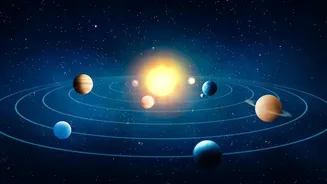
For decades, the concept of the habitable or 'Goldilocks' zone has guided our search for life-bearing planets. It defines the orbital region where a planet isn't too hot or too cold, allowing liquid water to potentially exist on its surface. This is a crucial
first step, as all life we know of depends on water. However, scientists now understand that this is a vast oversimplification. A planet's address in its solar system is only part of the story. True habitability depends on a complex interplay of factors, and simply being in the right zone is no guarantee that a world is hospitable to life.
The Protective Blanket of an Atmosphere
An atmosphere is non-negotiable for a life-bearing planet. It acts as a protective shield and a climate regulator. A sufficiently dense atmosphere traps heat through the greenhouse effect, keeping the planet's surface warm enough for liquid water. Without it, Earth's average temperature would plummet to well below freezing. It also shields the surface from harmful ultraviolet and X-ray radiation from its star and burns up small to medium-sized meteoroids. But the composition is key. Too much greenhouse gas can lead to a runaway effect, like on Venus, where the atmosphere is 100 times thicker than Earth's and the surface is scorching hot. Too little, as on Mars, and the atmosphere is too thin to provide significant insulation or protection.
The Rhythmic Dance of a Stable Orbit
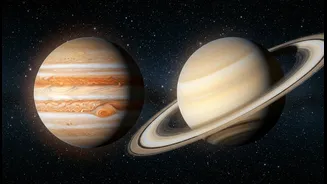
A planet's journey around its star is just as important as its average distance. The shape of this path, known as its orbital eccentricity, has a dramatic effect on climate stability. A planet on a nearly circular orbit, like Earth, receives a relatively consistent amount of energy throughout its year, leading to stable seasons. In contrast, a planet on a highly elliptical or 'stretched-out' orbit would experience wild temperature swings, getting blasted with heat when close to its star and freezing in the depths of space when far away. Such extreme variations could make it difficult for complex life to gain a foothold and evolve. The gravitational pull of giant planets in a solar system, like Jupiter and Saturn, plays a huge role in keeping orbits stable and circular.
The Temperament of the Parent Star
Not all stars are created equal, and the nature of the host star is a critical factor in a planet's habitability. Stars that are much larger and hotter than our Sun have wider habitable zones, but they burn through their fuel much faster, potentially not giving life enough time to evolve. On the other end, smaller, cooler stars like red dwarfs are the most common in our galaxy. Their habitable zones are very close to the star, which presents its own problems. These stars are known for being temperamental, frequently unleashing powerful flares of high-energy radiation. A planet orbiting closely could have its atmosphere stripped away by these flares and be constantly bombarded with lethal radiation, rendering it sterile even if it is at the right temperature for liquid water.