






Your New Job-Hunting Assistant
The endless task of tailoring a resume for each job can feel like a significant chore. For every application, you have to dissect the job description, identify keywords, and rephrase your accomplishments to align perfectly. This is where AI-powered resume tools
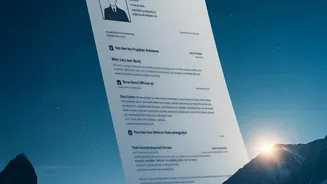
are changing the game. These platforms act as intelligent assistants that analyse a specific job posting and help you customise your resume in seconds. Instead of you manually scanning for important terms, the AI does it for you, suggesting ways to rephrase your bullet points and highlight skills that match exactly what the employer is looking for. Think of it as a tireless personal editor, dedicated to making your resume as relevant as possible for every opportunity.
How AI Matches You to the Role
The magic behind these tools lies in natural language processing. When you provide your base resume and the job description, the AI performs a comparative analysis. It scans the employer's text for crucial keywords, skills, and qualifications that are likely being screened for by Applicant Tracking Systems (ATS). Most large companies use ATS software to filter the high volume of applications they receive, making keyword alignment essential. The AI then suggests specific edits to your resume, from generating new, impact-driven bullet points to reordering your skills section. The goal is to mirror the language of the job ad, increasing your chances of passing the initial automated screening and catching the eye of a human recruiter.
The Benefits: Speed, Precision, and an ATS Edge
The most immediate benefit is a massive time saving. Manually customising a resume for dozens of applications is draining, but AI can produce a tailored draft in moments. This efficiency allows you to apply to more roles with higher-quality, targeted applications. Beyond speed, these tools offer precision by ensuring your resume includes the exact terminology recruiters and their software are searching for. This is particularly helpful for career changers, as AI can identify transferable skills that you might have overlooked. Some studies have even shown that candidates who use algorithmic writing assistance can be more likely to be hired, as their applications are better aligned with the job requirements.
The Risks: Sounding Generic and Losing Your Voice
However, over-reliance on AI carries significant risks. The biggest pitfall is creating a resume that sounds generic and robotic. Recruiters are becoming adept at spotting the formulaic language and uniform sentence structures that AI often produces. Some surveys indicate over half of hiring managers believe they can identify AI-generated text, and many view it negatively if it lacks personality. What they're really detecting isn't the AI itself, but laziness. A resume filled with buzzwords like "spearheaded" and "leveraged" without specific, quantifiable achievements can come across as inauthentic and may get rejected. The tool is only as good as the information you provide, and it can't invent your personal story or unique voice.
How to Use AI as a Smart Co-pilot
The key is to treat AI as a brainstorming partner, not a ghostwriter. Start by feeding it your detailed, human-written resume and a specific job description. Use the AI’s suggestions as a first draft or a source of inspiration. Scrutinise every suggested bullet point for accuracy and authenticity. Does it truly reflect your accomplishment? Is it backed by a real metric or story you can discuss in an interview? Your most important task is to edit the AI's output, infusing it with your own voice, personality, and specific examples. The final product should sound like you on your best day—clear, confident, and precise—not like a template. Use AI to handle the mechanical task of keyword matching, but reserve the art of storytelling for yourself.