





The Hierarchy of Urgency: 'Mayday' vs. 'Pan-Pan'
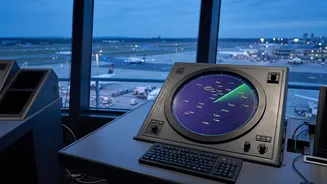
In aviation, emergencies are broadly classified into two tiers, communicated to Air Traffic Control (ATC) with specific phrases. A 'Mayday' call signifies a 'distress' condition. This is the highest-priority alert, reserved for situations where the aircraft
or its occupants are under grave and imminent danger, requiring immediate assistance. Think of an in-flight fire or a complete engine failure. On the other hand, a 'Pan-Pan' call indicates an 'urgency' situation. This means there is a safety concern that requires prompt attention, but the danger is not immediate. Examples include a partial engine issue on a multi-engine plane or certain system malfunctions that are serious but manageable. This distinction is the first layer in understanding why some emergencies are more time-critical than others.
Fire and Flight Controls: The Factor of Immediate Threat
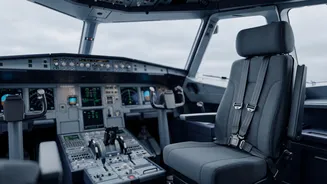
The single most time-critical situation a flight crew can face is an uncontrollable in-flight fire. Fire can spread rapidly, produce toxic smoke, and compromise the aircraft's structural integrity. This scenario demands immediate, aggressive action, often involving an emergency descent and landing at the nearest possible airport. Equally critical is a loss of primary flight controls. The core principle of managing any emergency is 'Aviate, Navigate, Communicate'. If pilots cannot 'aviate'—that is, control the aircraft's flight path—the situation is instantly perilous. While modern airliners have redundant systems, a significant failure of flight controls removes the pilots' most fundamental tool, making every moment that follows critical.
The Race Against Hypoxia: Cabin Depressurization
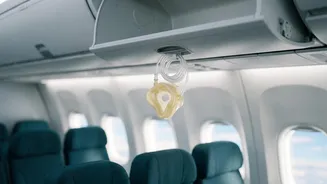
A sudden loss of cabin pressure at high altitude is another top-tier, time-critical emergency. While aircraft fly at altitudes of 30,000 to 40,000 feet, the cabin is pressurized to a much lower, more comfortable equivalent. If that pressure is lost, the crew is in a race against hypoxia—a lack of oxygen to the brain. At 40,000 feet, the 'Time of Useful Consciousness' (TUC) can be as short as 15 to 20 seconds. This is the window a pilot has to don an oxygen mask before their cognitive function and ability to take corrective action degrades. The immediate procedure is for the pilots to put on their masks and initiate a rapid descent to a safe altitude (typically below 10,000 feet) where supplemental oxygen is no longer needed. Any delay can be catastrophic.
The Human Element: Pilot Incapacitation and Medical Crises
An emergency doesn't always have to be mechanical. The sudden incapacitation of a pilot instantly creates a time-sensitive crisis, elevating the workload on the remaining pilot who must now fly the aircraft and manage the emergency alone. Similarly, a severe medical emergency in the cabin can escalate into a time-critical situation for the flight. While most in-flight medical issues are minor, such as fainting or nausea, a life-threatening event like a cardiac arrest or stroke forces a major decision. Though only about 4-7% of medical incidents lead to a flight diversion, pilots must quickly assess the situation with cabin crew and ground-based medical support to decide if landing immediately is necessary to save a life.
The 'Slow Burn' Problems: Manageable Failures
Contrast these immediate threats with what might be called 'slow-burn' emergencies. These are serious but not immediately catastrophic, affording the crew more time to think, plan, and consult checklists without rushing. An example could be the failure of a single hydraulic system on a plane with multiple redundancies, a landing gear that fails to retract after takeoff, or a fuel imbalance that needs to be managed. While these 'abnormal' situations require careful handling and will likely result in a precautionary landing, they do not pose an imminent threat to the aircraft's flyability or the occupants' lives. The pilots can work through the problem systematically, communicate their plan to ATC, and arrange for a safe, albeit not originally scheduled, landing.