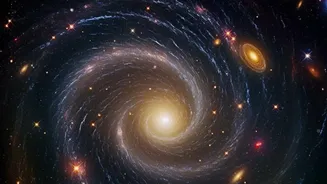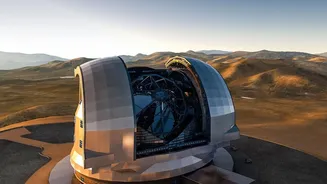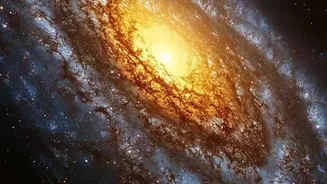



For decades, we have understood the universe to be about 13.8 billion years old. But what if it were almost twice that age? A new, provocative theory proposes the cosmos is actually 26.7 billion years old and claims to pass several key tests.
The Universe As We Know It
The current,
widely accepted theory of the universe is known as the Lambda-CDM (ΛCDM) model. It explains that the universe began with the Big Bang and has been expanding ever since. Based on measurements of the cosmic microwave background (the oldest light in the universe) and the rate of cosmic expansion, scientists have confidently placed the age of the universe at about 13.8 billion years. This model also relies on two mysterious components: dark matter and dark energy, which together are believed to make up about 95% of the cosmos but have never been directly detected.
A Radically Older Cosmos?
A new theory from University of Ottawa professor Rajendra Gupta challenges this entire picture. His model, called CCC+TL, proposes the universe is 26.7 billion years old. It does this by combining two concepts. The first is 'covarying coupling constants' (CCC), which suggests that the fundamental forces of nature are not constant and change over time. The second is 'tired light' (TL), an old idea suggesting that light particles (photons) lose energy as they travel across vast cosmic distances. According to Gupta, this combined effect, not just cosmic expansion, explains the redshift of distant galaxies.
Solving the 'Impossible' Galaxy Problem
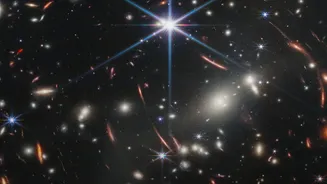
So, what are the 'new cosmological tests' the theory has passed? This refers to its ability to explain recent, puzzling discoveries from the James Webb Space Telescope (JWST). The JWST has spotted galaxies in the very distant, early universe that appear shockingly massive and mature—too developed for the short time they would have had to form in the 13.8 billion-year model. This is known as the 'impossible early galaxy problem'. Gupta's model solves this neatly: if the universe is 26.7 billion years old, these ancient galaxies would have had billions of extra years to grow, making their advanced state perfectly logical.
An Old Idea Gets a New Look
It's important to note that the 'tired light' concept is not new. First proposed in 1929, it has been largely dismissed by mainstream physics for decades because it failed key observational tests, such as explaining the surface brightness of distant galaxies. Critics pointed out that scattering light would also blur distant objects, which is not what we see. Gupta's model attempts to revive the idea by combining it with the concept of evolving physical constants, arguing this hybrid approach can account for observations without needing dark matter. His team claims the model successfully reproduces the rotation of 175 galaxies without invoking dark matter.
Is the Science Settled?
Not at all. While the CCC+TL model offers an intriguing solution to the JWST's early galaxy puzzle, it remains a fringe theory. The Lambda-CDM model, for all its mysteries, has been incredibly successful, explaining a vast array of cosmic observations for decades. Most cosmologists, while acknowledging the early galaxy problem, are looking for explanations within the standard model, such as more efficient early star formation or the effect of supermassive black holes. Gupta’s proposal represents a fundamental break from established physics and faces significant skepticism. Parts of the work have also not yet completed peer review.