




Quantum Computing in a Nutshell
Before diving into space, let's quickly demystify quantum computing. Traditional computers use bits, which are like light switches—either on (1) or off (0). Quantum computers use 'qubits'. Thanks to a principle called superposition, a qubit can be both
1 and 0 at the same time. Another principle, entanglement, links qubits together in such a way that they can influence each other instantly, no matter the distance. This ability to exist in multiple states and be interconnected allows quantum computers to process massive amounts of information in parallel, making them incredibly powerful for solving certain types of complex problems that would take a classical computer billions of years.
Unhackable Communication for Satellites
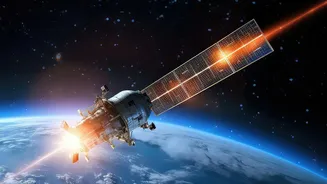
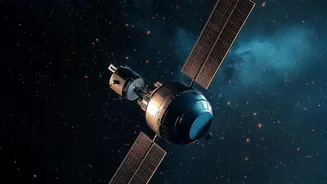
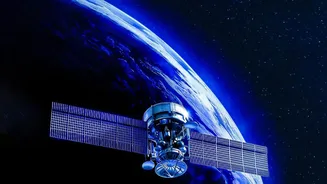
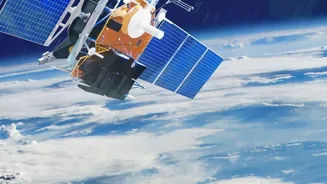
One of the most immediate and critical applications for India's space missions is secure communication. Conventional encryption, which protects our data today, relies on mathematical problems that are hard for normal computers to solve. However, a powerful quantum computer could theoretically break these codes. Quantum communication offers a solution based on the laws of physics itself. Technologies like Quantum Key Distribution (QKD) create encryption keys that are inherently secure. Any attempt by an eavesdropper to intercept the key would disturb its quantum state, immediately alerting the communicating parties. ISRO has already successfully demonstrated free-space QKD over a distance of 300 metres and is actively working toward satellite-based quantum communication to create hack-proof networks for military and strategic purposes.
Smarter, Faster Mission Planning
Space missions are exercises in extreme optimization. Calculating the most fuel-efficient trajectory for a spacecraft, coordinating a swarm of satellites, or processing vast amounts of data from a probe are monumental computational challenges. Quantum algorithms are uniquely suited for such optimization problems. For ISRO, this could mean designing more complex and ambitious missions with greater efficiency. Imagine planning a multi-planetary tour for a single probe or optimizing the real-time operations of the Gaganyaan mission with a level of precision we can't currently achieve. Quantum computing promises to solve these multi-variable problems faster, leading to better resource management and more ambitious scientific outcomes.
A New Generation of Super-Sensors
Beyond computing, quantum principles can be used to build hyper-sensitive sensors. These devices could revolutionize navigation and scientific observation from space. Quantum sensors could offer navigation capabilities that go far beyond current GPS, providing incredibly precise positioning. They could also be used for Earth observation, mapping gravitational fields with unprecedented detail to monitor climate change, water tables, and geological changes. For deep space missions, these sensors could detect faint gravitational waves or magnetic anomalies, opening new windows into our understanding of the universe. This falls in line with the National Quantum Mission's goal of developing highly sensitive magnetometers and atomic clocks for superior navigation and communication.
India’s National Quantum Mission
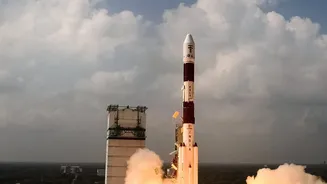
India is not just watching from the sidelines. The Indian government has approved the National Quantum Mission (NQM), a comprehensive initiative with a budget of over ₹6,000 crore to be spent between 2023 and 2031. This mission aims to foster research and development in quantum technology, making India a leading nation in the field. A key objective is developing satellite-based secure quantum communication over a range of 2,000 kilometres within India. ISRO is a major player in this mission, collaborating with institutions like the Raman Research Institute to develop the necessary technologies. The mission also focuses on building indigenous quantum computers, with a target of developing systems with 50 to 1,000 physical qubits within eight years.
The Challenges and The Road Ahead
The promise is immense, but the path is not without its hurdles. Quantum computers are still in their early stages of development and are extremely sensitive to their environment, requiring ultra-low temperatures and shielding from radiation—a significant challenge in the harshness of space. Building and launching quantum-ready satellites and developing the talent to run these systems will require sustained investment and collaboration between academia and industry. However, ISRO has a proven track record of overcoming complex technological barriers. The progress on QKD and the clear objectives laid out in the National Quantum Mission show a determined push to integrate this next-generation technology into India's space infrastructure.