





Beyond Abstract Knowledge
In a classroom, a child learns that a tree provides oxygen. This is a scientific fact, a piece of data to be memorised for an exam. It’s important, but it’s also abstract. Standing under that same tree, however, the lesson changes. The child feels the coolness
of its shade on a hot day, touches the rough texture of its bark, and sees ants marching up its trunk. They hear the rustle of its leaves and smell the damp earth at its roots. This is no longer just a fact; it's an experience. This sensory immersion forges a bond that a textbook cannot replicate. Environmental education confined to four walls risks becoming a list of problems to be solved, creating a generation that is aware but not necessarily invested. True investment comes from a personal relationship with the very thing we are trying to protect.
Learning Empathy for the Earth
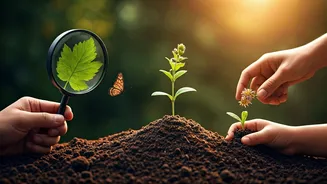
Empathy is not a concept that can be effectively taught through rote learning. It is cultivated through interaction and observation. When a child gently holds a ladybug, watches a spider weave its web, or helps tend to a small garden, they are learning a profound lesson in coexistence. They witness the fragility of life and the intricate dependencies that sustain it. This direct contact with other living beings fosters a sense of stewardship. The desire to protect a local park or a neighbourhood tree isn’t born from a statistic about deforestation; it’s born from the memory of playing in that park or climbing that tree. Outdoor experiences teach children that they are part of a larger ecological community, not simply its masters. This perspective shift is fundamental to building a generation of compassionate environmental guardians.
Understanding How Systems Work
Nature is the ultimate teacher of systems thinking. A forest, a pond, or even a puddle after a monsoon shower is a complex, living classroom. Here, children can see cause and effect in real time. They learn that decaying leaves enrich the soil, which in turn nourishes new plants. They see how the absence of rain affects the life in a pond. These are not isolated facts but parts of an interconnected web. In school, subjects are often siloed—biology, chemistry, physics. In nature, they are one and the same. This holistic understanding is critical for tackling complex environmental challenges like climate change and pollution, which are themselves problems of interconnected systems. Children who learn to see these connections early are better equipped to develop the innovative, cross-disciplinary solutions our future requires.
Building Resilience and Solving Problems
The natural world is unpredictable. It doesn't come with a user manual. A path might be muddy, a sudden shower might begin, or a planned route might be blocked. Navigating these small challenges builds resilience, adaptability, and problem-solving skills. A child learns to assess risk, make decisions, and cooperate with others to overcome obstacles. These are not explicitly 'green' lessons, but they are foundational to the character of a person who can face adversity, including the large-scale adversity of our environmental crisis. An air-conditioned, perfectly controlled indoor environment teaches comfort and convenience. The outdoors teaches grit. It prepares children not just to understand environmental problems, but to have the fortitude to endure and work through them.