


A Needle in a Cosmic Haystack
The primary targets for planetary defense are Near-Earth Objects (NEOs), a category of comets and asteroids nudged by gravity into orbits that bring them close to Earth. A subset of these, called Potentially Hazardous Asteroids (PHAs), require special
attention. NASA's goal is to find at least 90 percent of NEOs that are 140 meters or larger—big enough to cause regional devastation. The challenge is immense. These objects are often dark, small, and moving fast against a backdrop of billions of stars. The entire sky covers over 41,000 square degrees, a unit astronomers use to measure areas on the celestial sphere. Finding a threatening asteroid is like spotting a speeding piece of coal in the dark from millions of kilometres away.
The Tools of the Trade
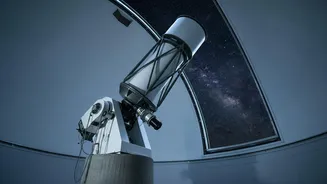
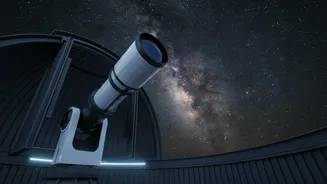
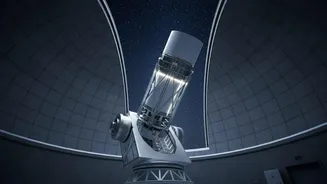
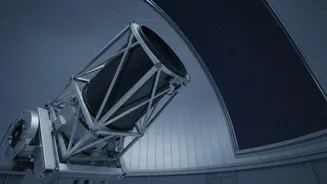
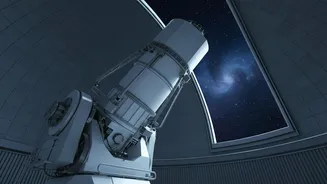
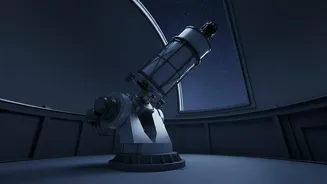
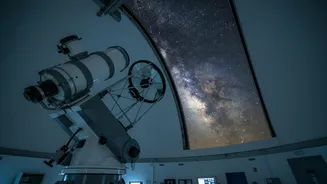
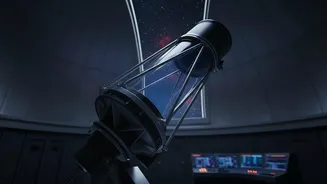
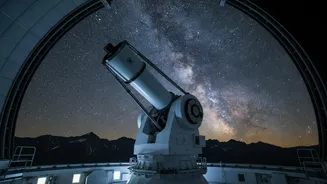
To tackle this monumental task, astronomers don't use telescopes that zoom in on single stars. Instead, they use wide-field survey telescopes designed to photograph huge patches of the sky at once. Key players in this effort include the Catalina Sky Survey (CSS) in Arizona and the Pan-STARRS and ATLAS systems in Hawai'i and other locations. The Asteroid Terrestrial-impact Last Alert System (ATLAS), for instance, consists of multiple telescopes that work together. Each telescope has a camera with a very wide field of view; a single ATLAS image can cover an area of the sky 100 times larger than the full moon. These systems are not just powerful, they are relentless, scanning the entire observable sky every few nights.
A Celestial Game of Spot the Difference
The core technique for finding NEOs is surprisingly straightforward: take pictures of the same patch of sky several times in one night and look for anything that moves. Systems like ATLAS take a series of four short exposures of a sky region, with about 10 to 15 minutes between each shot. Powerful computers then overlay these images. Stars and galaxies remain fixed in place, but an asteroid, being much closer to us, will appear to jump from one position to the next across the sequence of images. This movement is the tell-tale sign of a nearby solar system object. The software automatically flags these moving dots, creating a list of potential new discoveries.
From a Blip to a Calculated Risk
Once a candidate object is flagged, the work is far from over. The initial observations are immediately sent to the Minor Planet Center (MPC), the worldwide clearinghouse for all asteroid and comet data. The MPC posts the data online, allowing astronomers around the globe—both professional and amateur—to perform follow-up observations. Each new observation helps to refine the object's orbit. With enough data points, scientists at centers like NASA's Center for Near-Earth Object Studies (CNEOS) can project the asteroid's path far into the future, determining if it has any chance of hitting Earth. If a potential threat is identified, the information is shared through the International Asteroid Warning Network (IAWN).
The Future is (Almost) All-Seeing
Our ability to scan the heavens is getting a massive upgrade. The Vera C. Rubin Observatory in Chile, expected to begin its main survey soon, will be a game-changer for planetary defense. With its enormous 8.4-meter mirror and the world's largest digital camera, Rubin will survey the entire southern sky every few nights with unprecedented sensitivity. It is expected to find tens of thousands of new NEOs, drastically improving our catalogue of potentially hazardous objects. In preliminary tests alone, Rubin has already discovered thousands of previously unknown asteroids. Furthermore, upcoming space-based telescopes like NASA's NEO Surveyor will hunt for asteroids in infrared light, allowing them to spot dark objects that are difficult for ground-based optical telescopes to see. This next generation of sky surveys promises a much more complete picture of our cosmic neighborhood, ensuring we have the warning time needed to protect our planet.