






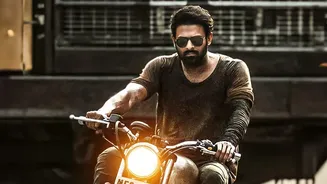

Enthiran (2010)
Long before 'pan-Indian' was a buzzword, director S. Shankar's sci-fi epic starring Rajinikanth and Aishwarya Rai Bachchan set a new benchmark. Made on what was then an unprecedented budget of around ₹150 crore, 'Enthiran' (released as 'Robot' in Hindi)
was a technical marvel. It brought Hollywood's Legacy Effects, known for their work on global blockbusters, to India for animatronics. The film's mind-bending climax, featuring an army of Chitti robots forming giant structures, was a watershed moment for visual effects in the country, proving Indian filmmakers could deliver world-class spectacle.
Baahubali: The Beginning (2015)
This is the film that arguably started it all. S.S. Rajamouli’s mythological fantasy didn't just break box office records; it shattered cultural and linguistic barriers. Made with a budget of approximately ₹180 crore, its grand vision of the Mahishmati kingdom, epic war sequences, and a cliffhanger ending captured the nation's imagination. 'Baahubali' pioneered the pan-Indian film model, proving that a story rooted in Indian mythology, when told with conviction and world-class VFX, could unite audiences nationwide.
Baahubali 2: The Conclusion (2017)
If the first film was a question, the sequel was a resounding answer. With a reported budget of ₹250 crore, 'Baahubali 2' was bigger, bolder, and more emotionally resonant. It didn’t just resolve the mystery of “Why Kattappa killed Baahubali?”; it delivered a cinematic experience so powerful that it became the first Indian film to cross the ₹1000 crore mark. Its monumental success cemented S.S. Rajamouli's status as a visionary and proved that the pan-Indian model was not a fluke but a sustainable and highly profitable strategy.
Padmaavat (2018)
Sanjay Leela Bhansali is known for his opulent, larger-than-life cinema, and 'Padmaavat' was his grandest statement yet. Despite numerous controversies that delayed its release, the film was a visual masterpiece. With a budget that swelled to over ₹215 crore, every frame was a painting, showcasing lavish sets, intricate costumes, and breathtaking cinematography. The film's commercial success, grossing over ₹570 crore, demonstrated the audience's appetite for historical epics when mounted with scale and artistic grandeur.
2.0 (2018)
The spiritual successor to 'Enthiran', '2.0' saw director S. Shankar double down on the spectacle. With a staggering budget estimated between ₹450-₹540 crore, it was the most expensive Indian film at the time of its release. Pitting Rajinikanth’s Chitti against Akshay Kumar’s avian-themed villain, the film was a VFX extravaganza from start to finish. It pushed the boundaries of what was technically possible in Indian cinema, using 3D technology and complex computer-generated imagery to create a one-of-a-kind action film.
K.G.F: Chapter 1 & 2 (2018, 2022)
The 'K.G.F' franchise put the Kannada film industry on the national map. The first film, made on a relatively modest budget, became a sleeper hit due to its stylish action, gritty tone, and Yash's powerful performance. Its success laid the groundwork for 'K.G.F: Chapter 2', which was made on a bigger budget of around ₹100 crore and became a box office juggernaut, grossing over ₹1200 crore worldwide. The franchise proved that a compelling 'masala' narrative, when packaged with slick production values and a pan-Indian release, could create a phenomenon.
RRR (2022)
After 'Baahubali', the world waited to see what S.S. Rajamouli would do next. He delivered 'RRR', a maximalist historical epic that defied expectations. Made on a mammoth budget of ₹550 crore, the film was a tour de force of action choreography and visual storytelling. From the iconic 'Naatu Naatu' song-and-dance sequence to the jaw-dropping animal attack scene, every moment was crafted for the big screen. The film's global success, including an Oscar for Best Original Song, announced to the world that Indian commercial cinema had truly arrived.
Brahmāstra: Part One – Shiva (2022)
Bollywood’s ambitious attempt at creating its own cinematic universe, the 'Āstraverse', began with 'Brahmāstra'. Director Ayan Mukerji spent years developing the project, which was mounted on a massive budget of over ₹410 crore, largely due to its extensive VFX work. The film aimed to bring Indian mythology into a modern, superhero-like context, creating a world of ancient celestial weapons. While the story drew mixed reactions, the sheer scale of its visual effects, with over 4500 VFX shots, was a milestone for Hindi cinema.
Jawan (2023)
Shah Rukh Khan’s collaboration with Tamil director Atlee resulted in 'Jawan', a high-octane action thriller that broke Bollywood records. Made on a reported budget of over ₹300 crore, it was designed as a pan-Indian spectacle from the ground up, bringing together talent from both North and South. The film’s slick action, mass-market appeal, and Shah Rukh Khan’s commanding presence propelled it to gross over ₹1150 crore worldwide. 'Jawan' solidified a new formula for Bollywood: blending a superstar’s appeal with the dynamic filmmaking style of the South.
Kalki 2898 AD (2024)
Blurring the lines between mythology and science fiction, 'Kalki 2898 AD' stands as one of the most expensive Indian films ever made, with a reported budget of around ₹600 crore. Featuring a star-studded cast including Prabhas, Amitabh Bachchan, and Deepika Padukone, the film presents a dystopian future inspired by Hindu scriptures. Its ambitious world-building, futuristic vehicles, and groundbreaking visual effects represent the latest high-water mark in India's quest to produce global-scale event cinema, proving that the era of the mega-budget spectacle is here to stay.