


The Oddball of the Solar System
If you could look down on our solar system from above the Sun's north pole, you'd see all the planets orbiting in a counter-clockwise direction. You'd also see that most of them—including Earth—rotate on their axis in that same counter-clockwise direction. This
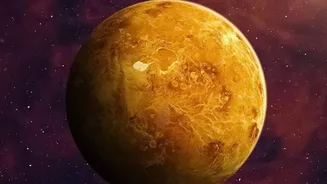
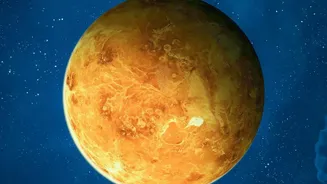
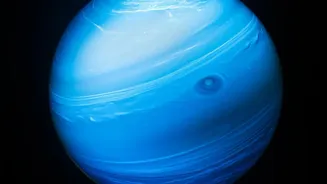
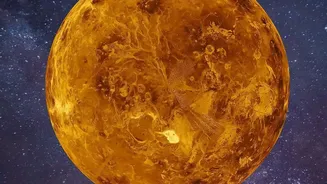
is called prograde rotation. But two planets are rebels: Uranus, which is knocked over on its side, and Venus, which spins slowly backwards in a clockwise direction. This backward spin is known as retrograde rotation. A day on Venus is longer than its year; it takes 243 Earth days to complete one rotation but only about 225 Earth days to orbit the Sun. This means that on Venus, the Sun rises in the west and sets in the east. So, how did our neighbour get so twisted?
Theory 1: A Cosmic Collision
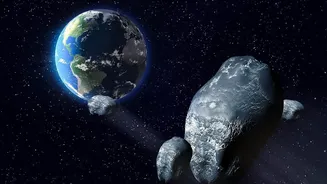
One of the longest-standing theories is that Venus wasn't born this way. Early in the solar system's history, about 4.5 billion years ago, things were a lot more chaotic. It was a cosmic shooting gallery, with massive objects called planetesimals frequently colliding. The leading idea is that a huge object, perhaps the size of a small planet, slammed into a young Venus. This colossal impact could have been powerful enough to not just slow Venus's original spin but actually reverse it entirely, or even flip the planet completely upside down. A similar impact is thought to have created Earth's Moon and knocked Uranus on its side. However, this theory has a major challenge: such a massive impact would likely have created a moon from the resulting debris, but Venus is mysteriously moonless. Recent simulations show a high-speed collision could explain the rotation without creating a lasting moon, but the exact conditions are still debated.
Theory 2: The Sun's Gravity and a Thick Atmosphere
A more recent and increasingly popular theory suggests that a violent collision wasn't necessary. Instead, Venus's strange spin could be the result of a long, slow dance between the Sun's immense gravity and the planet's crushingly thick atmosphere. Venus's atmosphere is about 90 times denser than Earth's and creates an extreme greenhouse effect, leading to surface temperatures of over 460°C. Over billions of years, the Sun's gravity would have created tidal forces on the solid body of Venus, trying to slow its rotation and lock it into facing the Sun, much like how our Moon is locked to Earth. This force alone would have slowed Venus down, but not reversed its spin. The secret ingredient is the atmosphere.
A Battle of Tides
The Sun's intense heat warms Venus's dense atmosphere, creating powerful 'atmospheric tides'—bulges and waves that move through the air. These atmospheric tides are so strong that they create a torque, or a twisting force, that works against the Sun's gravitational pull on the planet itself. Think of it as a celestial tug-of-war. The Sun's gravity pulls on the planet to slow it down, while the friction and flow of the super-heated, heavy atmosphere push in the opposite direction. Over eons, sophisticated models suggest that the atmospheric tides won this battle, first slowing Venus's original prograde spin to a halt and then slowly nudging it into the gentle retrograde rotation we see today. This theory neatly explains why the rotation is so slow and why it's retrograde, without needing to account for a missing moon or a perfectly aimed cosmic collision.