






The Brain's Busy Border
Our brain cells, or neurons, are constantly interacting with their environment. To survive, learn, and form memories, they must absorb nutrients, signaling molecules, and other materials from the fluid surrounding them. This vital process is called endocytosis.
Think of it as a cell's way of eating and drinking. For decades, scientists have studied how endocytosis works, knowing that when this process goes wrong, it can lead to the buildup of toxic proteins—a hallmark of neurodegenerative diseases. But a key piece of the puzzle was missing: what controls the constant flow of traffic across the cell's border?
Meet the Cellular Gatekeeper
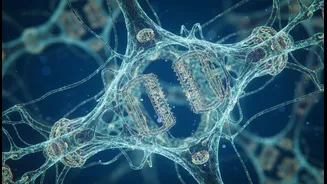
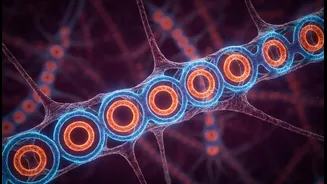
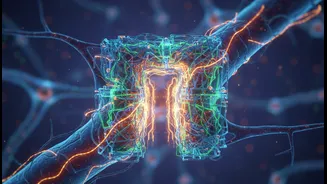
Researchers at Penn State have identified a previously underappreciated structure that acts as the master controller. It’s called the membrane-associated periodic skeleton, or MPS. Located just beneath the neuron's surface, the MPS is a flexible, lattice-like structure made of repeating rings of proteins. For years, it was thought that the MPS was just passive scaffolding, helping the neuron maintain its shape. But using advanced super-resolution microscopy, which allows scientists to see things 10,000 times smaller than a human hair, they discovered its much more active and critical role.
A Shock Absorber for the Cell
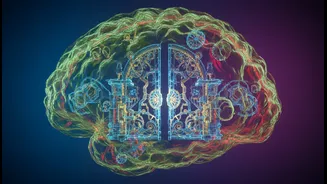
The new findings, published in the journal Science Advances, show that the MPS acts as a physical gatekeeper, regulating nearly every major pathway of endocytosis. “You can think of it as a gatekeeper, guarding this physical barrier,” explained Ruobo Zhou, an assistant professor at Penn State who led the research. When a neuron needs something, the MPS opens specific gates to let it in. In its default state, however, it acts as a barrier, slowing down the intake process. This function is crucial. By acting as a brake, the MPS prevents the neuron from being overwhelmed and absorbing too much, too quickly. It's a built-in safety mechanism that keeps the cell’s internal environment stable and healthy.
When the Gatekeeper Weakens
This is where aging and disease enter the picture. The study found that the MPS deteriorates as we get older and in the presence of neurodegenerative conditions like Alzheimer's. When this internal skeleton weakens, the gates are effectively left unguarded. Neurons begin to absorb materials from their surroundings much more rapidly and indiscriminately. This includes the harmful amyloid precursor proteins associated with Alzheimer's disease. The researchers discovered a devastating feedback loop: the increased uptake of toxic material further weakens the MPS, which in turn allows even more harmful substances to enter, accelerating the neuron's decline and eventual death.
A New Path for Fighting Brain Disease
This discovery shifts our understanding of how cellular damage begins in the aging brain. Rather than trying to deal with toxic proteins after they’ve already accumulated, we might be able to prevent them from getting in at dangerous levels in the first place. The researchers believe this opens a brand-new avenue for potential therapies. "Preserving or stabilizing the MPS might offer a way to slow the early, hidden cellular changes that precede Alzheimer's symptoms," said Jinyu Fei, the study's lead author. The goal would be to develop treatments that reinforce this natural cellular shield, keeping the gatekeeper strong and functional for longer.