




Meet the Cosmic Sparkler
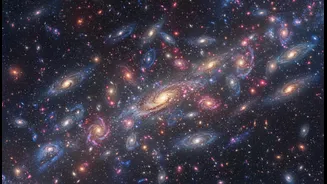
Deep in the southern sky, an object nine billion light-years away is rewriting our understanding of galactic history. Nicknamed 'The Sparkler,' it isn't a single star but an entire young galaxy surrounded by a glittering halo of compact star clusters.
Discovered using the James Webb Space Telescope (JWST), this galaxy is special because we see it as it was nine billion years ago, when the universe was just 4.5 billion years old. This provides astronomers with a perfect snapshot of a galaxy in its awkward teenage years, a phase our own Milky Way went through long ago. The Sparkler gets its name from the dozens of dense, shining globular clusters orbiting it, which look like tiny sparkles against the dark of space.
A Telescope and a Cosmic Magnifying Glass
Finding something so distant and relatively small is an incredible feat, made possible by a combination of powerful technology and a lucky cosmic alignment. The James Webb Space Telescope, with its unparalleled infrared sensitivity, was able to detect the faint light that has traveled for nine billion years to reach us. However, even for the JWST, this would have been a challenge without a natural phenomenon known as gravitational lensing. A massive galaxy cluster located between Earth and The Sparkler acts like a giant magnifying glass, bending and amplifying the light from behind it. This effect magnified The Sparkler by a factor of 100, bringing its stunning details into focus for the first time.
A Mirror to the Milky Way's Youth
The reason astronomers are so excited about The Sparkler is that it looks like a near-perfect model for the early Milky Way. Our home galaxy is a cosmic cannibal; it grew to its current massive size by absorbing, or 'accreting,' smaller satellite galaxies and their star clusters over billions of years. The Sparkler is currently doing the exact same thing. Observations show it is in the process of swallowing a smaller satellite galaxy along with its system of globular clusters. While The Sparkler is currently only about 3% of the Milky Way's mass, scientists believe it is on a similar growth trajectory and will eventually evolve into a large spiral galaxy much like our own.
Reading the Clues in the Stars
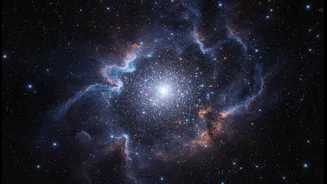
The 'sparkles' themselves—the globular clusters—are cosmic fossils that hold the key to this story. These dense groupings of up to a million stars are known to be incredibly old. By studying the light from The Sparkler's clusters, astronomers found something amazing. Some of the clusters were formed very early, close to when the universe first began forming stars. These are like the original, native-born clusters of The Sparkler. Others, however, had different chemical compositions and ages, matching what would be expected from a smaller, incoming galaxy. This confirmed that we are witnessing a galactic merger in real-time, providing a direct look at the primary process that built up massive galaxies like the Milky Way.
Fresh Perspectives on Our Ancestry
This discovery provides a powerful, fresh perspective on our own galactic ancestry. While astronomers have long theorised that the Milky Way was built through mergers, direct evidence has been hard to find. The remnants of these ancient collisions are now mixed into our galaxy's vast halo. Studying The Sparkler is like having a film of the Milky Way's construction. It moves the theory from a computer model to a direct observation. By watching this younger galaxy build itself, we gain invaluable insights into how the structure of our own galaxy, from its central bulge to the ancient globular clusters in its halo, came to be. It's a profound connection, linking a faint smudge of light billions of light-years away to the cosmic home we inhabit today.