





A Decades-Old Cosmic Puzzle
The story begins over 50 years ago with two brilliant physicists. In 1969, Sir Roger Penrose proposed that a spinning black hole could theoretically shed some of its immense rotational energy. He imagined an object entering a special region just outside
the black hole's point of no return, called the ergosphere. In this zone, spacetime itself is dragged around by the black hole's spin. Penrose calculated that if the object split in two, one part could fall into the black hole while the other escaped with more energy than the original object started with, effectively stealing energy from the black hole's rotation. A couple of years later, in 1971, physicist Yakov Zel'dovich expanded on this, suggesting that it wouldn't just work for objects, but for waves too. He theorized that any wave—like light or radio waves—striking a rapidly rotating, absorbing object could bounce off with increased amplitude, having extracted energy from the object’s spin. This phenomenon became known as rotational superradiance.
The Impossible Experiment
For half a century, Zel'dovich's prediction remained a fascinating but untestable idea. The catch was the incredible speed required. To get a wave to amplify, the object’s surface would need to rotate faster than the wave's own oscillations. For light waves, this speed is astronomically high, far beyond what any physical material can withstand without being torn apart by centrifugal forces. So, while the maths was sound, building a machine that could physically spin fast enough to demonstrate the effect was considered practically impossible. Scientists have tried using analogues like sound waves in rotating foam or water in a draining vortex, but directly testing the principle for electromagnetic waves in a controlled way remained out of reach. The theory was stuck on the blackboard, a tantalizing piece of cosmic physics with no way to verify it in a lab.
A Breakthrough With 'Synthetic Rotation'
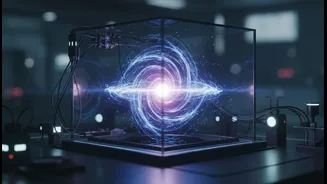
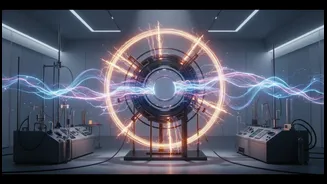
Now, a team of researchers at the Advanced Science Research Center at the CUNY Graduate Center in Manhattan has found a brilliant workaround. Instead of trying to build a machine with impossibly fast moving parts, they built one with no moving parts at all. Their device is a ring-shaped network of electronic resonators designed to interact with radio waves. The genius of the experiment lies in what the team calls 'synthetic rotation'. Instead of physically spinning the ring, the researchers rapidly modulated the electrical properties of the resonators in a carefully timed pattern that travelled around the circle. This clever engineering created an effect that, from the perspective of an incoming radio wave, was mathematically and physically identical to encountering an object rotating at an extreme, otherwise unreachable, speed. They created the conditions of extreme rotation without any actual motion.
Success: The Waves Emerge Amplified
The result, published in the journal Nature, was a resounding success. The team sent radio waves into their stationary device and watched them interact with the synthetic rotation. Just as Zel'dovich predicted, the waves that entered the system came out amplified. They had successfully extracted energy from the time-engineered synthetic rotation, emerging with a measurable increase in power. According to the researchers, the waves with the correct properties essentially stole energy from the system, perfectly reproducing the core physics of the Penrose-Zel'dovich process. This achievement moves a foundational concept about the universe's most extreme objects from abstract theory into the realm of practical, experimental science. It's the first time this effect has been demonstrated in such a clean, controllable way, confirming the 50-year-old theory.
From Black Holes to Future Tech
While the experiment was inspired by black holes, its implications go far beyond astrophysics. The ability to amplify specific waves using this method opens up a new toolkit for manipulating waves. The researchers suggest this breakthrough could have significant consequences for a variety of fields. Because the system can be precisely controlled, it could lead to new types of broadband selective amplifiers for use in more advanced wireless communication systems and radar technologies. The team is now planning to scale down the technology to test how it works with light in photonic devices and even with quantum systems. Success in those areas could pave the way for faster data processing in computer chips or novel quantum science applications. This experiment hasn't just confirmed a theory; it has created a brand-new platform for exploring wave physics.