





Seeing the Unseeable
Imagine trying to find an invisible person in a crowded room. You couldn't see them, but you could spot their influence: a chair moving on its own, a drink floating in mid-air, or a path clearing through the crowd. Astronomers use a similar principle
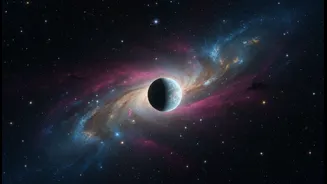
to find black holes. They can't see the object itself, but they can observe its powerful gravitational effects on the space and matter surrounding it. By studying these interactions, scientists can not only confirm a black hole's presence but also measure its properties, like mass and location, with incredible accuracy. These indirect methods turn a cosmic void into a measurable phenomenon.
Watching the Stars Dance
One of the most compelling pieces of evidence comes from watching stars. At the center of our own Milky Way galaxy lies a supermassive black hole named Sagittarius A*. Though it is invisible, scientists have spent decades tracking the orbits of stars near it. These stars move at incredible speeds, whipping around a central, empty point in space as if tethered by an unseen force. By applying Kepler's laws of planetary motion, astronomers can calculate the mass of the object these stars are orbiting. The immense mass—over four million times that of our sun—packed into such a small area leaves only one possible conclusion: it must be a supermassive black hole. This celestial dance is a clear gravitational fingerprint.
A Bright Accretion Disk
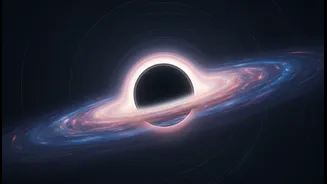
While black holes themselves are dark, their immediate surroundings can be some of the brightest places in the universe. As gas, dust, and debris from nearby stars get pulled in by a black hole's gravity, they don't fall straight in. Instead, they form a flat, spinning ring of material called an accretion disk. The immense friction and gravitational forces within this disk heat the material to millions of degrees, causing it to glow intensely. This superheated matter emits powerful radiation, particularly in the form of X-rays, which telescopes can detect. The characteristics of this radiation, such as its energy and brightness, can tell scientists a great deal about the black hole's properties, including its spin.
Bending the Fabric of Spacetime
Albert Einstein's theory of general relativity predicted that massive objects would warp the fabric of spacetime, much like a bowling ball placed on a trampoline. This warping effect bends the path of light that passes nearby. This phenomenon, known as gravitational lensing, is another key tool for finding black holes. If a black hole passes in front of a distant star, its gravity acts like a lens, bending and magnifying the starlight. From our perspective on Earth, this can cause the background star to appear distorted, brighten, or even split into multiple images. For a perfect alignment, the light of the background object can be smeared into a circle called an Einstein ring. These distortions provide telltale evidence of a massive, unseen object.
Listening for Ripples in the Universe
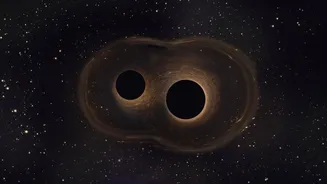
The latest and most groundbreaking method for detecting black holes involves listening for gravitational waves. These are ripples in the fabric of spacetime itself, created by the most cataclysmic events in the cosmos, such as the collision and merger of two black holes. First predicted by Einstein and first detected in 2015, these waves radiate outward from their source at the speed of light. Highly sensitive instruments like the Laser Interferometer Gravitational-Wave Observatory (LIGO) can detect these faint tremors as they pass through Earth. By analyzing the signal, scientists can learn about the masses of the colliding black holes and the violent details of their merger, opening an entirely new window into studying these enigmatic objects.