






A Message from the Edge of the Solar System
Ever since NASA's New Horizons spacecraft flew past Pluto in 2015, it has been rewriting the book on what we thought we knew about dwarf planets. Instead of a simple, cratered ball of ice, the probe revealed a world with towering mountains of water ice, vast
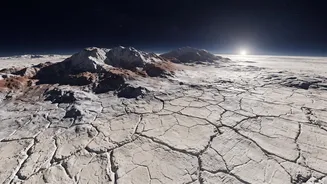
plains, and a hazy atmosphere. The most stunning feature is Sputnik Planitia, the western lobe of Pluto's famous heart-shaped region. This enormous basin, larger than Texas and Oklahoma combined, is filled with frozen nitrogen. For years, scientists have been poring over the images, and a recent analysis has yielded a startling conclusion: this frozen heart might still be beating with geological activity.
Not Water, But Flowing Nitrogen
When we think of liquid activity, we naturally think of water. But on Pluto, where surface temperatures plummet to around -230°C, water is as hard as rock. The candidate for this recent activity is nitrogen. New analysis of images showing the northern part of Sputnik Planitia reveals dark streaks and diffuse patches along the boundaries of large, polygon-shaped convection cells in the ice. According to researchers, these patterns strongly resemble features on Earth's glaciers that have been wetted by liquid. Since Pluto's thin, cold atmosphere makes nitrogen rain impossible, the evidence points to a source from below. Computer models support the idea that liquid nitrogen may be welling up from beneath the massive glacier through cracks and fissures, briefly flowing across the surface before refreezing.
The Engine of a Frozen World
The discovery raises a central question: what is powering this activity? Pluto is too small and distant from the Sun to have a hot, molten core like Earth's. The leading theory is that intense pressure from the kilometers-deep nitrogen glacier is enough to melt the nitrogen ice at its base, creating a liquid layer. This liquid nitrogen, being more buoyant than the solid ice above it, could then be forced to the surface through conduits, similar to how magma rises on Earth. This process suggests that Pluto is not a geologically dead world. Some scientists also theorize that Pluto may harbor a vast, subsurface ocean of liquid water, which, while not directly feeding the surface, could provide just enough residual internal heat to help mobilize the nitrogen ices above.
A Land of Ice Volcanoes
The evidence for a dynamic Pluto doesn't stop with flowing nitrogen. Elsewhere on the dwarf planet, New Horizons spotted massive structures that are believed to be cryovolcanoes—or ice volcanoes. Unlike volcanoes on Earth that spew molten rock, cryovolcanoes would erupt a slushy, toothpaste-like mixture of water ice, ammonia, and other chemicals. The lack of impact craters on and around these features suggests they are geologically young, possibly having been active within the last 100 to 200 million years. This separate line of evidence reinforces the idea that Pluto has retained enough internal heat to power significant geological processes long after its formation, something few expected from such a small, cold body.
Rewriting the Rules of the Outer Solar System
This ongoing examination of Pluto's surface is fundamentally changing our understanding of icy worlds. If a dwarf planet on the frigid edge of the solar system can remain geologically active for billions of years, it suggests that other large bodies in the Kuiper Belt could be similarly complex and dynamic. As Alan Stern, the principal investigator for the New Horizons mission, has stated, "Pluto never stops surprising us." The discovery of recent liquid flows and cryovolcanism opens up a new chapter in planetary science, suggesting that the conditions for geological activity—and perhaps even subsurface oceans—may be more common in the cosmos than we ever imagined.