


India's Next Interplanetary Leap
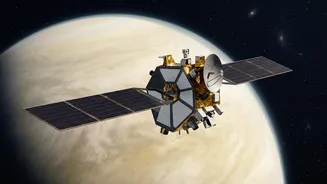
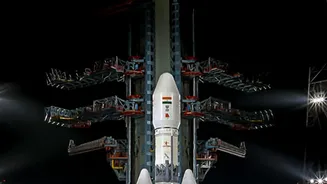
Shukrayaan-1, which translates from Sanskrit as 'Venus Craft', is the Indian Space Research Organisation's first dedicated mission to Venus. Following the historic successes of Mangalyaan (Mars Orbiter Mission) and Chandrayaan, this new venture marks
India's growing confidence and capability in deep space exploration. The mission, which was formally approved in September 2024, will involve placing a sophisticated orbiter into a long, elliptical path around Venus. This orbiter will be packed with about 100 kg of scientific instruments designed to perform a comprehensive study of the planet from above. The current timeline targets a launch in March 2028, a date chosen to ensure the most fuel-efficient trajectory between Earth and Venus.
Why Study Earth's 'Evil Twin'?
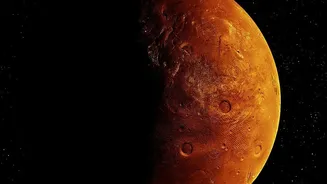
Venus is often called Earth's twin because the two planets are remarkably similar in size, mass, and composition. However, they evolved down dramatically different paths. While Earth became a haven for life, Venus turned into a hellscape. It suffers from a runaway greenhouse effect, with a crushing atmosphere made mostly of carbon dioxide that is 92 times denser than Earth's. This toxic blanket of air traps so much heat that surface temperatures reach over 460°C, hot enough to melt lead. Thick clouds of corrosive sulphuric acid perpetually cover the planet. By studying why our twin went so wrong, scientists hope to learn more about how Earth-like planets evolve and gain invaluable insights into our own planet's climate.
Peering Through the Clouds
The primary goal of Shukrayaan-1 is to investigate Venus's atmosphere and surface in unprecedented detail. A key instrument will be a high-resolution Synthetic Aperture Radar (SAR), which has the ability to pierce through the thick cloud cover and map the planet's volcanic surface. Scientists are eager to find out if Venus is still geologically active. Another groundbreaking instrument is a ground-penetrating radar, which will be the first of its kind to study the planet's shallow subsurface. These tools will investigate volcanic hotspots, lava flows, and the overall geology of Venus. The mission will also study the structure, composition, and dynamics of the atmosphere, trying to understand its mysterious 'super-rotation', where the atmosphere circles the planet faster than the planet itself spins.
Searching for Clues in the Atmosphere
One of the most intriguing aspects of Venus is its atmosphere, particularly the upper layers where conditions are less extreme. Shukrayaan-1 will analyze how the solar wind—a stream of charged particles from the Sun—interacts with the Venusian ionosphere. This is crucial for understanding how Venus lost its water over billions of years. The mission will also carry instruments developed in collaboration with international partners, including Sweden. Some payloads will investigate the atmospheric chemistry in detail. This has become particularly interesting after controversial observations of phosphine gas in Venus's clouds in 2020—a gas that on Earth is strongly associated with life. While the presence of phosphine is still debated, Shukrayaan-1 will be equipped to provide valuable new data on the chemical makeup of this complex and uncharted atmospheric environment.