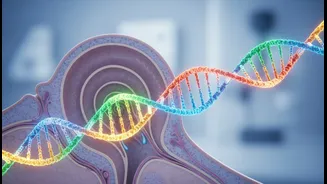






The Silent World of OTOF Deafness
Hearing is a complex process, but for some, the breakdown happens at a microscopic level. Congenital deafness caused by mutations in the OTOF gene is one such condition. Individuals with this type of hearing loss, known as DFNB9, are typically born with all the necessary
structures of the inner ear, including the sensory hair cells that detect sound waves. The problem lies in a single missing protein: otoferlin. This crucial protein acts as a messenger, enabling the ear's hair cells to communicate with the auditory nerve and send sound signals to the brain. Without functional otoferlin, the signals never leave the ear, resulting in profound deafness from birth despite an otherwise healthy auditory system. This specific condition accounts for a small but significant percentage of genetic hearing loss cases, affecting an estimated 200,000 people worldwide.
Delivering the Missing Genetic Code
The new gene therapy treatments, with names like AK-OTOF and DB-OTO, are designed to address this specific genetic error directly. The concept is elegant: if the body can't produce otoferlin because of a faulty gene, the solution is to provide the cells with a correct copy of that gene. To do this, scientists use a modified, harmless adeno-associated virus (AAV) as a delivery vehicle. This viral vector is loaded with a functional version of the human OTOF gene. Through a surgical procedure similar to a cochlear implant operation, this genetic payload is carefully infused directly into the fluid of the cochlea in the inner ear. Once inside, the AAV delivers the new gene to the sensory hair cells, effectively giving them the correct instructions to begin producing the otoferlin protein, restoring the broken link in the chain of hearing.
A Symphony of Firsts
The results from recent clinical trials have been nothing short of remarkable. Researchers in multiple studies have reported that a majority of participants, many of them young children, experienced significant hearing restoration, often within weeks of the single-dose treatment. In one groundbreaking trial, an 11-year-old who had been profoundly deaf since birth regained hearing to the point of only having mild-to-moderate loss within a month. In another study involving 42 participants, 90 percent showed hearing improvement, with some children able to perceive whispers and hold conversations for the first time. The therapy has proven safe and well-tolerated, with no serious adverse effects reported. These successes represent more than just a medical breakthrough; they are life-altering moments for families who never expected their children to hear their voices.
What This Means for the Future
While this therapy currently targets a rare form of deafness, its success is a powerful proof-of-concept for the entire field of genetic medicine. It demonstrates that targeted gene replacement in the delicate inner ear is not only possible but highly effective. This opens the door for developing similar treatments for other, more common forms of genetic hearing loss. Researchers are already working on adapting the platform to target genes like GJB2, the most frequent cause of congenital deafness. Companies like Eli Lilly and Regeneron are investing heavily, exploring various gene therapy and editing technologies to expand their hearing loss portfolios. Challenges remain, including understanding outcome variability and ensuring long-term stability, but the initial victories in OTOF-related deafness have ignited optimism that a cure, not just management, for many genetic hearing conditions is on the horizon.