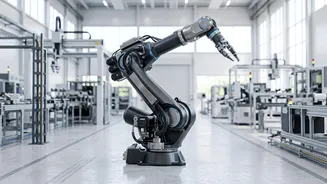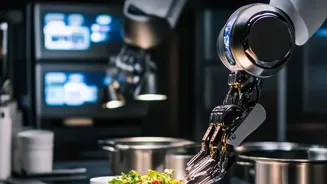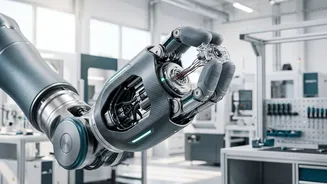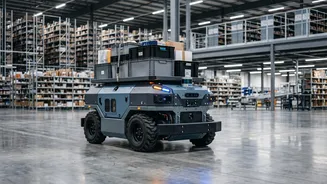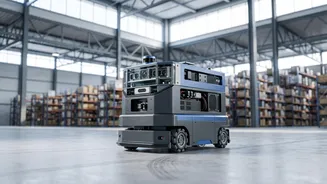





A massive new investment in Eka Robotics signals a new chapter for automation. The company just secured $150 million to advance its mission: creating intelligent robots that can handle physical tasks with superhuman speed and adaptability.
The Landmark Investment
Eka Robotics,
a startup at the cutting edge of physical artificial intelligence, recently announced a $150 million Series A funding round. The investment was co-led by prominent venture capital firms Andreessen Horowitz (a16z) and F-Prime, catapulting the company's valuation to an impressive $1.45 billion. This significant injection of capital is not just a vote of confidence in Eka but a major bet on the future of automation. The funds are earmarked to help the company scale its technology, expand its engineering teams, and accelerate the deployment of its robots to commercial partners in sectors like manufacturing, warehousing, and logistics. Investors noted that solving dexterous manipulation is one of the biggest opportunities in robotics, especially as labour shortages affect many industries globally.
What Makes Eka Robotics Different?
For decades, industrial robots have been powerful but limited. Most are programmed for highly specific, repetitive tasks in structured environments, like a car assembly line where every part is in the exact same place every time. They lack the versatility to handle real-world messiness. Eka Robotics, founded in 2024 by MIT professor Pulkit Agrawal and former Google DeepMind researcher Tuomas Haarnoja, aims to overcome this limitation. Their approach is to build a single, general-purpose AI model that can work across different objects, tasks, and environments without needing to be reprogrammed for each new challenge. The goal is to create robots that don't just mimic human actions but master the physics behind them to achieve superhuman performance.
The 'Vision-Force-Action' Breakthrough
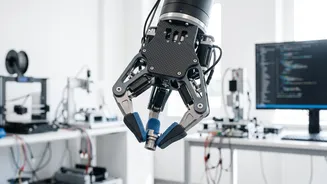
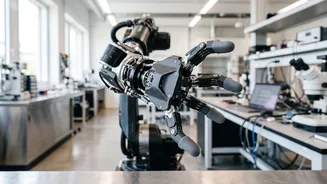
The magic behind Eka's technology is its 'Vision-Force-Action' (VFA) model. Unlike traditional robots that rely mainly on vision, Eka's robots combine sight with a sophisticated sense of touch. They are equipped with force-sensitive grippers that provide real-time feedback, allowing the robot to feel an object's properties and adjust its grip on the fly. This is crucial for what engineers call the 'last millimetre problem'—the final, delicate moments of grasping an object. Instead of being trained on data from human demonstrations, the VFA model learns through trial and error in a physics simulator. Using this reinforcement learning, Eka can generate thousands of hours of robot experience in minutes, teaching the AI an intuitive understanding of physics that translates from the simulation to the real world.
Superhuman Speed and Dexterity
The results of this approach are already remarkable. Eka's robots can perform pick-and-place tasks at a speed of approximately 1,500 operations per hour, more than double the average human rate of around 600 per hour. They demonstrate a success rate of over 95% even with objects they have never encountered before. The same robot that can handle delicate items like produce can also perform more complex tasks like screwing in a light bulb or inserting wires, showcasing a level of generalisation that has long been a goal in robotics. This ability to handle a wide variety of items without custom programming represents a significant leap forward, reducing the time it takes to deploy new robotic systems from weeks to mere hours.
Why It Matters for India
While Eka Robotics is based in the US, its technological advancements hold immense promise for India's burgeoning manufacturing and logistics sectors. As India pushes forward with initiatives like 'Make in India' and aims to become a global manufacturing hub, efficiency and automation are key. The high cost and complexity of traditional robotics have been a barrier to widespread adoption, especially for small and medium-sized enterprises. General-purpose robots like those Eka is developing could offer a more flexible and cost-effective solution. They could be deployed in warehouses for sorting and packing, in electronics assembly for delicate tasks, and in food processing to handle variable products. This technology has the potential to boost productivity, improve quality control, and enhance the competitiveness of Indian industries on a global scale.