






A New Kind of World
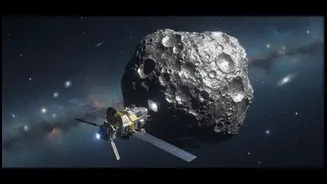
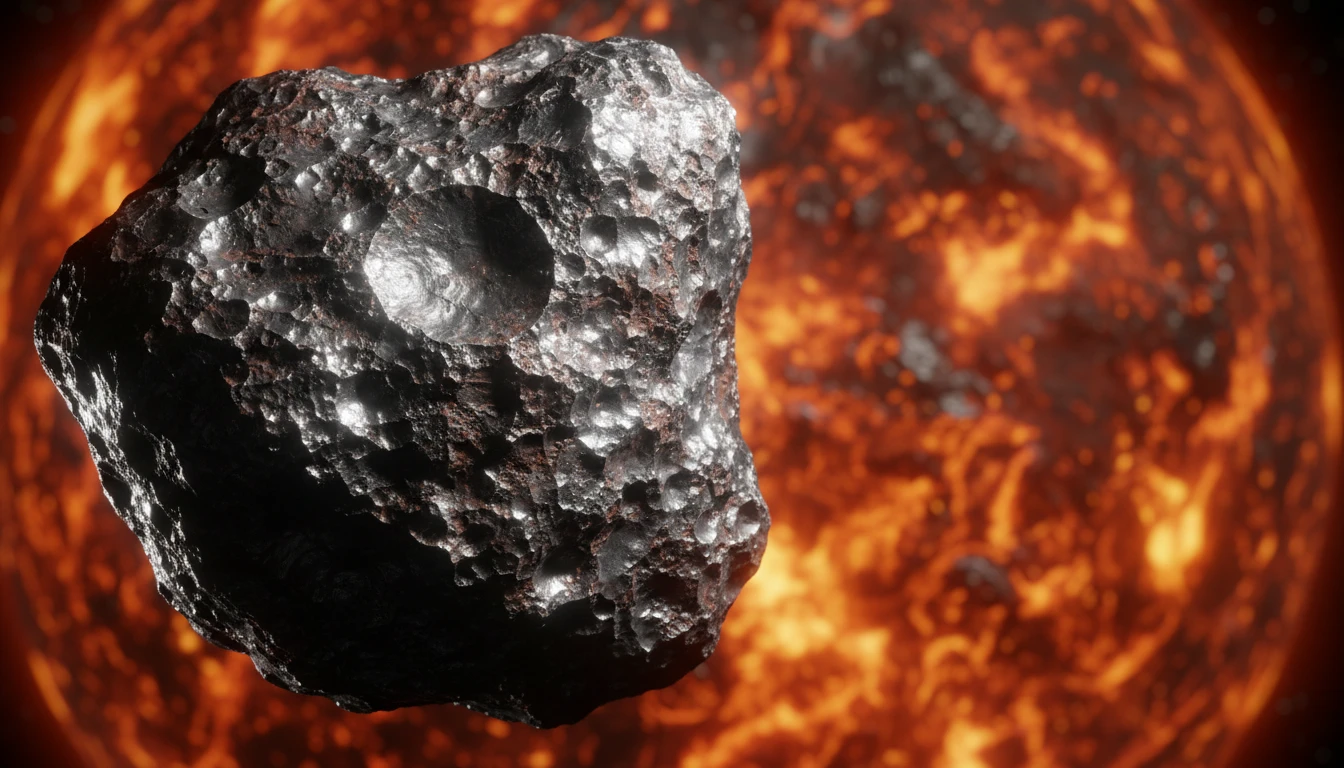
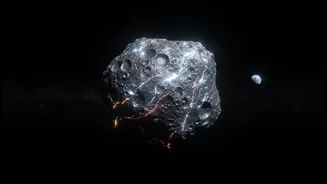
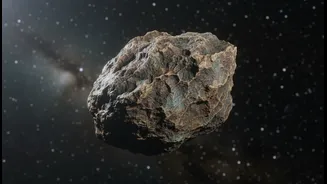
Deep in the main asteroid belt between Mars and Jupiter lies 16 Psyche, an object unlike any other visited by a spacecraft. While most asteroids are rocky or icy, Psyche is believed to be incredibly rich in metal, primarily iron and nickel. Scientists
have a fascinating theory: Psyche could be the exposed core of a planetesimal, a building block of a planet from the early solar system that had its rocky outer layers stripped away by violent collisions. Visiting Psyche offers a rare chance to study a planetary core, something we can't do with our own Earth. The mission, which launched in October 2023, is designed to determine if Psyche is a core or some other kind of primordial object we've never seen before.
The Toolkit for a Metal World
To study this mysterious world, the Psyche spacecraft is equipped with a suite of specialised instruments. The Multispectral Imager, a pair of identical high-resolution cameras, will capture images of the surface. These aren't just ordinary pictures; by using different filters, the imagers can help distinguish between metallic and silicate (rocky) materials on the asteroid. Then there's the Gamma-Ray and Neutron Spectrometer (GRNS). This instrument will map the asteroid's elemental composition by detecting the unique energy signatures that elements emit when bombarded by cosmic rays from space. Finally, a Magnetometer will search for any signs of a remnant magnetic field, which would be strong evidence that Psyche was once part of a molten planetary core.
From Deep Space to Earth: The Role of Telemetry
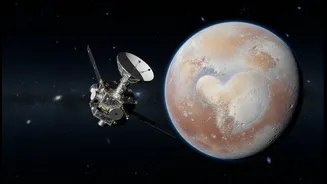
Having incredible instruments is only half the battle; the data needs to get back to Earth. This is where telemetry comes in. Telemetry is the automated process of collecting data from distant sources and transmitting it for monitoring and analysis. The Psyche spacecraft uses its large, high-gain X-band radio antenna to send vast amounts of scientific information and health updates back to NASA's Deep Space Network. This very same radio system does double duty. By analysing tiny shifts in the radio waves caused by the asteroid's gravity, scientists can precisely measure Psyche's gravitational field, giving them clues about its mass, rotation, and internal structure. The mission is also testing a new laser communication system called DSOC, which can transmit data at much higher rates than conventional radio systems.
Painting a Picture with Data
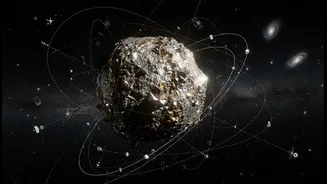
The spacecraft will not begin its detailed mapping until it enters orbit around the asteroid in August 2029. Once it arrives, it will enter a series of four orbits, each one successively closer to the surface. From the highest orbit, it will characterize the asteroid's basic properties. In closer orbits, the imagers will create detailed 3D topographic maps of the entire surface. The GRNS will simultaneously build a map of the chemical elements present. By overlaying these different data maps—topography, mineral composition, elemental makeup, and gravity—scientists can create a comprehensive picture of Psyche. They'll be able to see if a specific crater is made of mostly metal or has a different composition, providing a richer understanding than a simple photograph ever could.
Why Craters Hold the Key
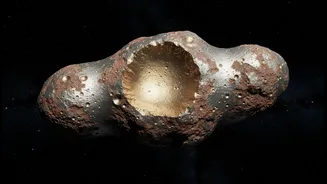
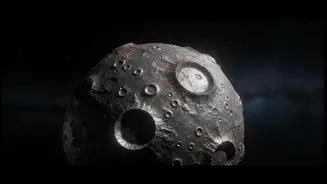
Impact craters are crucial to understanding Psyche's history. They act as natural drill holes, excavating material from below the surface. The shape and features of craters on a metal body are expected to be very different from those on a rocky one. By studying the distribution, depth, and relative ages of craters, scientists can piece together the timeline of collisions that shaped the asteroid. Furthermore, by analyzing the composition of the material ejected from these craters, they can learn if Psyche's interior is a uniform mix of metal and rock or if it has distinct layers, as a planetary core would. Each crater is a window into the violent history and fundamental nature of this unique metal world, helping us understand the building blocks of planets like our own.