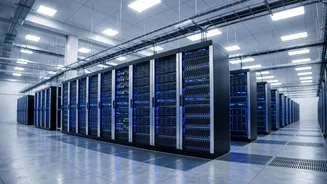





The digital revolution powered by Artificial Intelligence is creating an unprecedented boom in a critical, yet often invisible, industry. A new forecast from Crisil Ratings reveals just how massive this opportunity is for India's data centres.
An Investment Supercycle
According
to a recent report by Crisil Ratings, India's data centre capacity is on the verge of a five-fold explosion, projected to jump to 7.5 gigawatts (GW) by March 2030. This massive expansion is expected to attract over Rs 3 lakh crore (approximately $31.7 billion) in investments over the next four years. The primary drivers behind this 'investment supercycle' are the relentless rise of enterprise digitalisation, soaring data consumption, and, most significantly, the computationally intensive demands of generative artificial intelligence (GenAI). Unlike standard computing, AI models require vast processing power, fuelling a surge in demand for the specialised infrastructure that data centres provide.
The AI Effect and Hyperscaler Demand
The demand isn't just speculative; it's backed by concrete commitments. Global cloud providers, often called 'hyperscalers', are aggressively leasing capacity to run their AI and cloud services. Crisil notes that nearly half of the upcoming data centre capacity is already committed under long-term contracts, some stretching from 15 to 20 years. This provides significant revenue certainty for developers. Existing facilities are already running at about 90% utilisation, while over 95% of the capacity currently under construction has been pre-contracted. By 2030, it is expected that these hyperscalers will account for 75-80% of all leased capacity in India, up from around 60-65% in 2026.
Power: The Critical Bottleneck
While the demand is clear, a major challenge is emerging: power. Data centres are incredibly energy-intensive, and the new wave of AI-focused facilities requires even more electricity for processing and advanced cooling systems. Crisil's report highlights that timely grid connectivity has become the most critical factor for the successful expansion of the sector. The scale of this challenge is immense. Nearly three quarters of the upcoming 6 GW of capacity is concentrated in just three cities: Visakhapatnam, Mumbai, and Hyderabad. By 2030, the power demand from data centres in these cities could equate to 80%, 60%, and 20% of their entire current peak electricity demand, respectively. This puts enormous pressure on local power grids and underscores the urgent need for transmission infrastructure upgrades.
India's Competitive Edge
Despite the power challenge, India holds several structural advantages that make it an attractive data centre hub. According to Anand Kulkarni, a Director at Crisil Ratings, development costs in India are about 20% lower than in competing Asia-Pacific markets. This is due to more competitive land, construction, and labour costs. When combined with lower power tariffs, it results in rental rates that can be 30–35% cheaper than in peer markets. Furthermore, the potential to develop large data centre campuses powered by renewable energy aligns perfectly with the sustainability goals of global hyperscalers, further strengthening India's competitive position.