





More Than Just a Pretty Picture
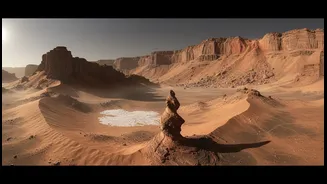
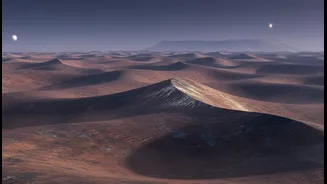
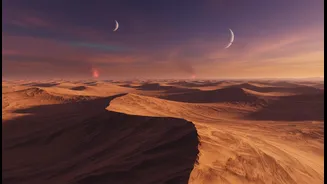
The dark dunes of Mars, often found pooled inside ancient impact craters, are some of the most captivating features on the planet. To the casual observer, they are a beautiful, almost artistic contrast to the planet's reddish plains. To planetary scientists,
however, they are invaluable data points. These dunes are dynamic geological formations, actively shaped by the thin Martian atmosphere, and they hold a physical record of the planet's climate, both past and present. By studying their shape, composition, and movement, researchers can piece together the history of wind patterns and atmospheric conditions on Mars, turning a stunning landscape into a scientific chronicle.
Volcanic Sands of Another World
Unlike the pale, quartz-based sands that form most dunes on Earth, the sands of Mars' dark dunes are fundamentally different. They are composed largely of mafic minerals like pyroxene and olivine. These are dark, rock-forming minerals that originate from volcanic rock, specifically basalt, which is common across the Martian surface. This composition tells a story of the planet's volcanic past. The sand is essentially weathered basaltic rock, broken down into fine particles over eons and then gathered by the wind. Some studies suggest these minerals were once buried and later exposed, protecting them from chemical alteration when Mars may have had more water on its surface.
Reading the Martian Winds
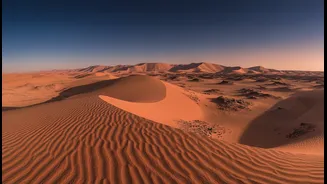
The shape and orientation of a dune are direct indicators of the winds that formed it. Scientists can map prevailing wind directions across the planet by analysing dune formations. Crescent-shaped dunes, known as barchans, are particularly useful, as their horns point downwind. By observing these and other dune types, like transverse and star dunes, researchers have inferred complex wind patterns, often influenced by local topography like crater rims and mountains. Sometimes, layers within a single dune field show different alignments, revealing how wind directions have shifted over long periods of time—a direct clue to significant climate changes in Mars' history.
Frozen in Time, Yet on the Move
For a long time, scientists debated whether Martian dunes were active relics of a past climate or if they were still moving today. Thanks to high-resolution images from orbiters like NASA's Mars Reconnaissance Orbiter (MRO), we now know the answer is both. While some dune fields appear to be static, or 'frozen' in time, many are actively migrating. Scientists have measured the movement of entire dunes, some as thick as 200 feet, crawling across the landscape at a rate comparable to some dune fields in Antarctica. This was a surprise, given Mars' thin atmosphere, and it shows that aeolian (wind-driven) processes are a dominant force shaping the planet's surface in the current era.
A Record of Climate Shifts
The dunes provide a layered history of Martian climate. Some research has shown ancient dune fields, now hardened into rock, that point to a climate and atmospheric pressure from a billion years ago that might have been similar to today's. More recent discoveries, including those from China's Zhurong rover, found evidence of a dramatic climate shift just 400,000 years ago. This change, linked to the end of Mars' last major ice age, is recorded in how younger dark ridges, called transverse aeolian ridges (TARs), formed on top of older dunes at a different angle. This indicates a major shift in wind patterns as the planet's axial tilt changed, altering the climate and showing how these dunes serve as a logbook of planetary evolution.