








What Happened on Flight AI 2030?
On October 14, Air India flight AI 2030, a Boeing 787 carrying passengers from Frankfurt to Delhi, was diverted to Jaipur after a security alert was triggered. As the aircraft entered Indian airspace, Air Traffic Control (ATC) in Mumbai noticed the plane
was transmitting 'squawk 7500'—the internationally recognized transponder code for unlawful interference, or a hijacking. This immediately set off a multi-agency security response. Following established protocol, the flight was ordered to divert to the nearest suitable airport, which was Jaipur. Upon landing, the aircraft was directed to a remote isolation bay, where security forces, including the Central Industrial Security Force (CISF) and a Bomb Detection and Disposal Squad, surrounded it to begin a thorough inspection.
The Mystery of the 'Hijack' Signal
The core of the incident lies in that four-digit code: 7500. Pilots use a device called a transponder to communicate with ATC, and specific codes are reserved for emergencies. While the signal indicated a hijacking, the pilots of AI 2030 quickly informed controllers that the flight was operating normally and they had not intentionally set the code. This created a confusing picture for authorities on the ground. Despite the crew's assurances, security protocols are designed to be rigid and err on the side of caution. An active 7500 signal cannot be ignored, regardless of verbal communications. The investigation is now focused on how the code was transmitted. Senior pilots have noted that accidentally entering the code is highly unlikely on a modern aircraft like the Boeing 787, as it requires manual input of each digit. This has led to speculation about a potential technical malfunction or a brief, erroneous signal. A similar incident occurred a day earlier on another airline in Germany, where a cockpit radio malfunction led to a false hijacking alert.
Anatomy of a Security Response
The response to the AI 2030 alert demonstrates a global safety system working as designed. When a serious alert like a hijack code is detected, a precise chain of events is triggered. ATC's primary job is to isolate the potential threat and get the aircraft on the ground safely and away from populated areas or other air traffic. This is why AI 2030 was diverted to Jaipur instead of continuing to the much busier Delhi airport. Once on the ground, the aircraft is treated as a high-level threat until proven otherwise. Passengers and crew were evacuated while authorities conducted a complete search of the plane, baggage, and cargo. In Delhi, the elite National Security Guard (NSG) was placed on standby, ready to be deployed if the situation escalated. While it may seem like an overreaction in hindsight, this robust, pre-planned response is critical for handling genuine threats effectively.
Radar Data, False Alarms, and Ghost Blips
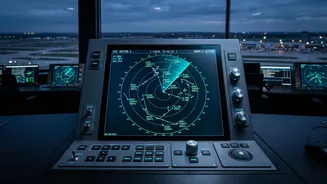
The headline mentions 'radar data', which is central to how air traffic is monitored. Primary radar works by bouncing radio waves off objects, creating 'blips' on a screen. Secondary radar interrogates an aircraft's transponder, which sends back detailed information like identity, altitude, and speed. Alerts can be triggered not just by emergency codes but also by unusual radar data, such as a plane deviating from its flight path or a transponder suddenly failing. Sometimes, atmospheric conditions or electronic interference can create 'ghost blips' or 'phantom tracks'—radar returns that look like an aircraft but aren't actually there. Controllers are trained to assess these, but any unidentified blip near a commercial flight path is treated seriously, often forcing other aircraft to be rerouted as a precaution. These systems are built to be hypersensitive; a false alarm is seen as a far better outcome than a missed threat.