





Start With Just Your Eyes
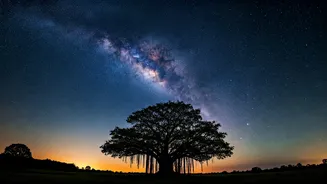
The biggest misconception about stargazing is that you need an expensive, complicated telescope. You don’t. The best astronomical tool you have is the one you were born with. A clear night sky, far from city lights, is filled with thousands of visible
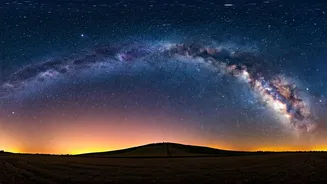
stars, the hazy band of the Milky Way, and even passing satellites. Before you spend a dime, the first step is simply to go outside, lie back, and look up. Let your eyes adjust to the darkness for about 20-30 minutes—avoid looking at your phone screen!—and you’ll be stunned by how much you can see. This simple act of observation is the foundation of the entire experience, reminding us that the universe is accessible to everyone.
Find Your Darkness
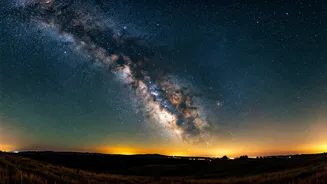
To truly see the cosmos, you need to escape light pollution. The glow from cities, suburbs, and even small towns can wash out all but the brightest stars and planets. Your mission is to find a patch of dark sky. Start by using a light pollution map online (like DarkSiteFinder or the International Dark-Sky Association’s map) to locate nearby parks, nature preserves, or rural areas with less artificial light. State and national parks are often excellent choices. Even driving 30-45 minutes out of a major metropolitan area can make a dramatic difference. Look for a spot with an open view of the sky, away from direct streetlights or building lights. This single step will have the biggest impact on what you can see.
Let Your Phone Be Your Guide
While your phone's screen is the enemy of night vision, its brain is your best friend. A good stargazing app can transform a confusing canopy of stars into a navigable map. Apps like SkyView Lite, Star Walk 2, or Stellarium use your phone's GPS and compass to identify exactly what you're looking at when you point it at the sky. They can show you the names of constellations, locate planets like Jupiter and Saturn, and alert you to visible satellites or the International Space Station passing overhead. For a more family-friendly experience, set your app to its 'red light mode.' This preserves your night vision while still giving you all the information you need to feel like an expert guide for your loved ones.
Gear Up, But Keep It Simple
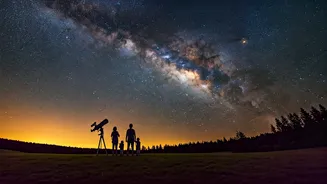
If you're ready for a slight upgrade, skip the beginner telescope and get a decent pair of binoculars. A standard 7x50 or 10x50 pair is perfect for astronomy. Binoculars are portable, easy to use, and offer a wide field of view that makes finding objects simple. They are magnificent for exploring the craters of the Moon, spotting the four Galilean moons orbiting Jupiter, or sweeping through the dense star fields of the Milky Way. The other essential piece of gear is a red flashlight or headlamp. Red light allows you to see your surroundings and read a star chart (or your phone) without ruining the dark-adaptation of your eyes, a mistake that can set you back another 20 minutes.
Make It a Cozy Event
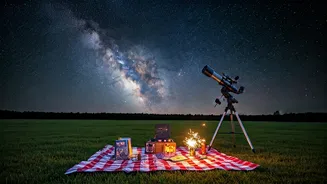
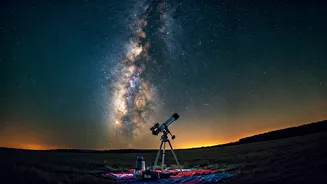
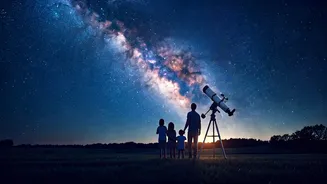
The 'loved ones' part of the headline is the most important. The goal isn't just to see stars; it's to create a shared memory. Turn your stargazing outing into a special occasion. Pack warm blankets or sleeping bags, comfortable folding chairs, and a thermos of hot cocoa or tea. Bringing along favorite snacks makes any activity feel more like a celebration, especially for kids. Don't pressure yourself to identify every object in the sky. Instead, focus on the experience: tell stories, listen to the quiet sounds of the night, and simply enjoy the peaceful feeling of being together under a vast, glittering sky. The conversation and connection are just as important as the constellations.
Know a Few Celestial Hits
To get started, it helps to have a few easy targets in mind. The Moon is the most obvious and rewarding object for any beginner, especially with binoculars. Look for the 'terminator'—the line between its light and dark sides—where craters and mountains are cast in dramatic relief. Next, look for planets. Venus is the incredibly bright 'evening star' or 'morning star,' while Jupiter is often the brightest point of light in the night sky. Saturn’s rings are a challenge for binoculars but are sometimes visible as a slight elongation. For constellations, start with easy-to-find shapes like the Big Dipper (part of Ursa Major) or Orion with his distinct three-star belt in the winter. Knowing just a few of these 'greatest hits' can provide a wonderful starting point for your cosmic tour.