

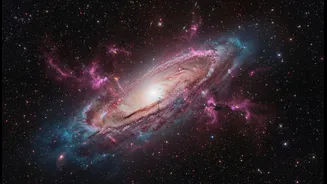
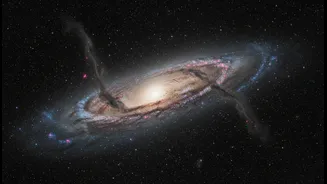
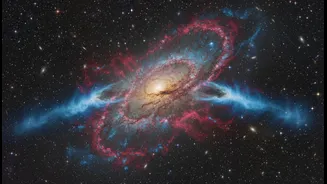


Our Cosmic Next-Door Laboratory
At just 11 to 13 million light-years away, Centaurus A is practically a next-door neighbour in cosmic terms. This proximity has made it one of the most studied objects in the sky, a perfect laboratory for understanding the dramatic forces that shape galaxies.
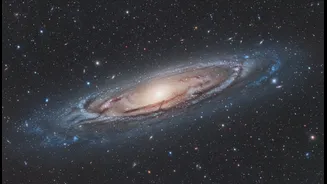
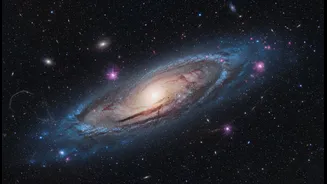
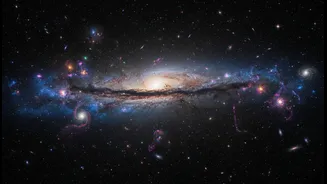
Visually, it’s defined by a striking, warped band of dust, the most obvious clue to its turbulent history. Scientists have long known this feature is the remnant of a colossal collision; about two billion years ago, a large elliptical galaxy merged with a smaller, gas-rich spiral galaxy. This cosmic crash left behind the distinctive dusty structure and triggered waves of intense star formation, earning Centaurus A the classification of a 'starburst galaxy'. But until recently, that thick dust has acted like a curtain, hiding the galaxy's most active regions from view.
A New Vision Through Infrared Eyes
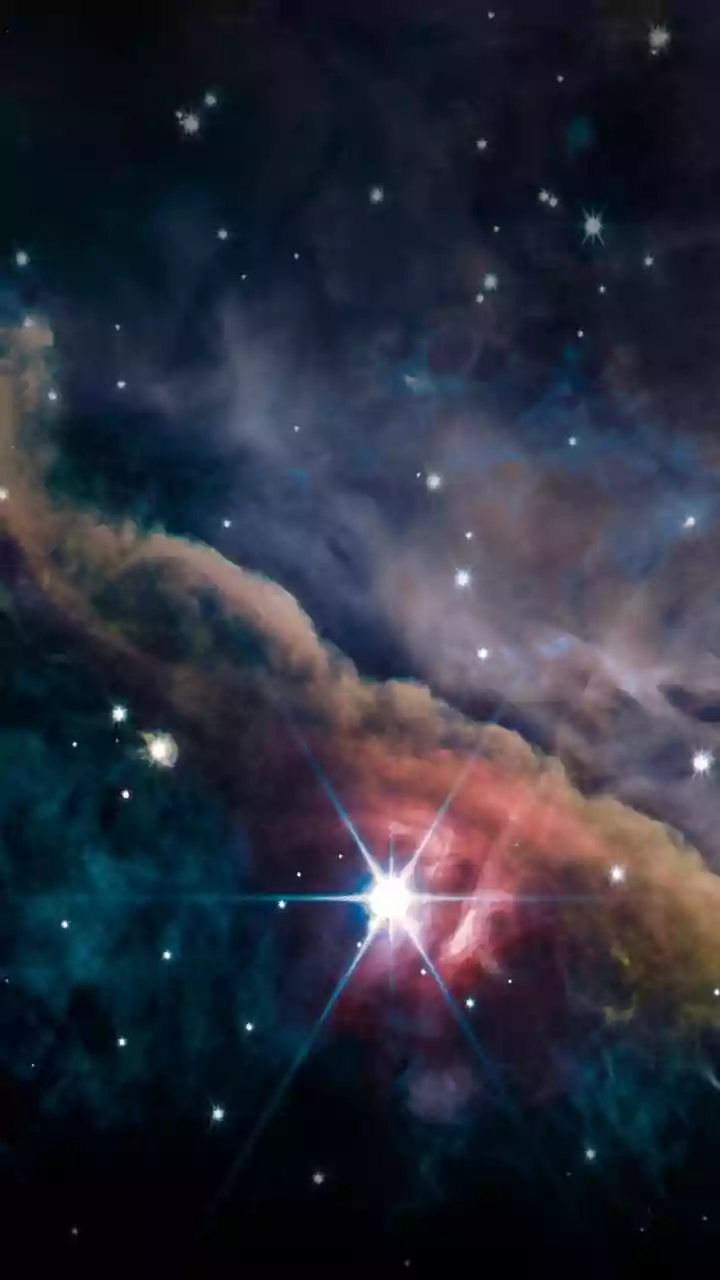
The game has changed thanks to the James Webb Space Telescope (JWST). To celebrate its fourth year of operations, NASA released breathtaking new images of Centaurus A. Unlike the Hubble Space Telescope, which primarily sees visible light, Webb is designed to see in infrared. This allows it to peer straight through the dense dust clouds that have long obscured the galaxy’s core. Where previous infrared telescopes like the retired Spitzer could see large-scale structures, they lacked the power to resolve individual stars. Webb's incredible sensitivity now cuts through the haze, revealing a densely packed tapestry of millions of individual stars and intricate structures for the first time. What once looked like a grainy glow is now a field of countless stellar points, each holding clues to the galaxy's past.
The Engine Roars to Life
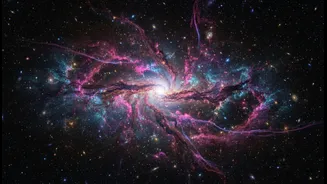
At the heart of Centaurus A lies a supermassive black hole, an engine actively feeding on surrounding gas and dust. Webb’s new observations provide an unprecedented look at this active galactic nucleus (AGN). The images showcase fast-moving ionised gas flowing outward, likely driven by powerful jets of energy launched by the black hole. These jets, which blast material at nearly half the speed of light, have a profound impact on the entire galaxy. One of the biggest questions in astronomy is how a black hole influences its host galaxy, and Centaurus A offers a front-row seat to this complex relationship. The data shows the black hole's activity can both trigger star formation by compressing gas, and quench it by blowing the raw materials away.
A Story Written in the Stars
The new details are not just beautiful; they are a form of galactic archaeology. By resolving individual stars, astronomers can now begin to build a precise timeline of Centaurus A’s evolution. They can distinguish between older stars that existed before the merger, those born during the violent collision, and the newest generation of stars forming in its aftermath. The images also revealed surprising and mysterious structures within the dust itself, including intricate filaments, glowing clouds, and a strange, S-shaped feature near the core that scientists are still working to understand. These details provide a vivid record of how galaxies grow, change, and interact with the cosmic behemoths at their centres.