


A Cosmic Crash in Stunning Detail
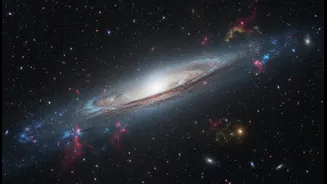
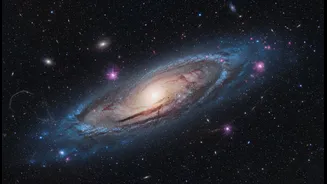
Located a relatively close 11 to 13 million light-years away, Centaurus A is one of the most studied objects in the southern sky. For decades, astronomers have known it was strange. Its bright, elliptical body is sliced through by a thick, dark lane of dust,
the tell-tale sign of a messy history. Scientists theorise that about two billion years ago, a large elliptical galaxy devoured a smaller spiral galaxy. This colossal merger event makes Centaurus A an ideal natural laboratory for studying one of the most dramatic processes in the universe: how galaxies collide, merge, and evolve. Until now, however, that central, dusty region has remained largely hidden from view.
Peering Through the Dust with Webb
This is where the James Webb Space Telescope (JWST) changes the game. While the Hubble Space Telescope sees primarily in visible light, which is blocked by cosmic dust, Webb is designed to see in infrared. Its powerful instruments, MIRI and NIRCam, can pierce through the obscuring veil of Centaurus A's core. Where previous infrared telescopes like Spitzer saw large, hazy structures, Webb provides unprecedented clarity and depth. The result is an image that resolves the fuzzy glow into a densely packed tapestry of millions of individual stars. This ability to see star by star allows astronomers to perform what they call “galactic archaeology,” reading the galaxy's history in its stellar populations.
The Anatomy of a Galactic Merger
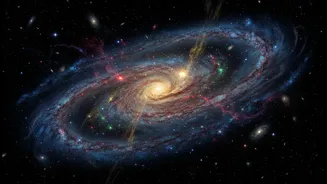
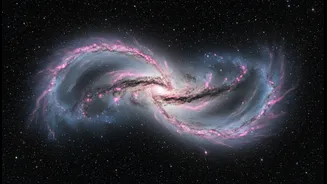
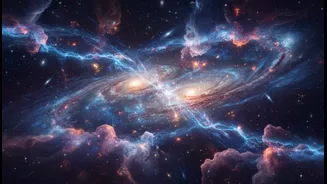
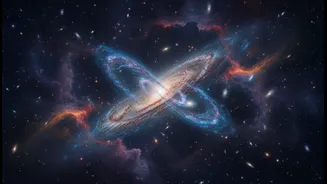
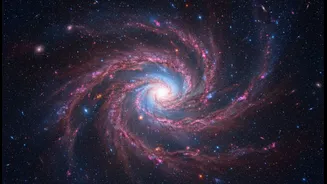
When galaxies collide, it’s not like a car crash where things smash to bits. Galaxies are mostly empty space, so individual stars rarely, if ever, hit each other. Instead, the collision is a gravitational dance that unfolds over hundreds of millions of years. As the two galaxies approach, their mutual gravity distorts their shapes, pulling out long tails of stars and gas. The vast clouds of interstellar gas and dust within each galaxy, however, do collide violently. This collision compresses the gas, triggering a massive burst of new star formation, known as a starburst. Eventually, the two galaxies completely merge, their distinct structures erased and reformed into a single, larger, and often more chaotic elliptical galaxy.
Connecting the Dots in Centaurus A
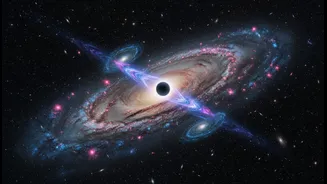
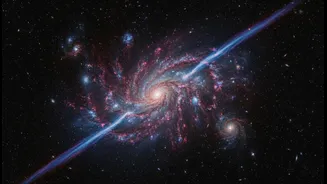
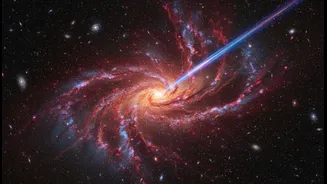
Webb’s new image makes this abstract process tangible. The intricate, glowing filaments of dust revealed by MIRI are the raw materials churned up by the collision. The glowing red points scattered throughout are stellar nurseries, regions where the collision-induced shockwaves have ignited furious star birth. By resolving individual stars, scientists can now distinguish between the older stars that existed before the merger and the younger generations born during and after the chaotic event, creating a direct timeline of the galaxy’s evolution. Furthermore, the image provides a clearer view of the supermassive black hole at the galaxy's core, which is actively feeding on the debris from the merger and blasting out powerful jets that shape the entire galaxy. Webb’s observations reveal how this central engine can both trigger star formation by compressing gas and quench it by blowing material away entirely.
A Glimpse into Our Own Future
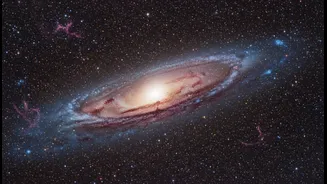
Studying Centaurus A is not just an academic exercise; it’s a preview of our own cosmic destiny. Our Milky Way galaxy is on a collision course with our nearest large neighbour, the Andromeda galaxy. In about 4.5 billion years, they will begin a long merger process that will ultimately combine them into a single, giant elliptical galaxy. While that date is far in the future, understanding the dynamics of the Centaurus A merger helps astronomers refine their models and predict what will happen to our corner of the universe. The detailed view from Webb provides a crucial piece of the puzzle, turning a distant, violent event into a powerful lesson on the life cycle of galaxies.