





An Orbital Battlefield
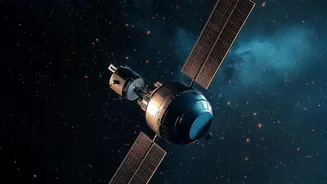
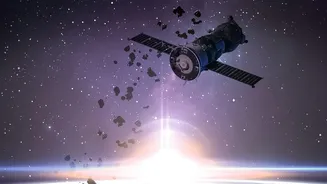
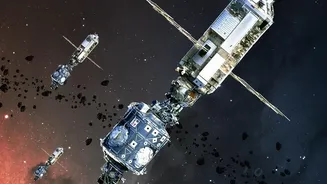
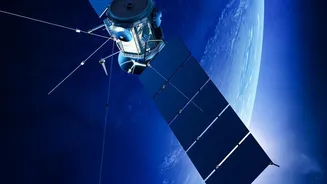
Low Earth Orbit (LEO), the zone from about 160 to 2,000 kilometres up, is becoming dangerously crowded. It’s home to thousands of active satellites crucial for communication, navigation, weather forecasting, and national security. But it’s also littered
with over a million pieces of untrackable debris—defunct satellites, spent rocket stages, and fragments from past collisions. Travelling at speeds approaching 28,000 kilometres per hour, even a paint fleck carries enough kinetic energy to cripple a multi-crore satellite. Experts have long warned of the Kessler Syndrome, a chain reaction where one collision creates thousands more pieces of debris, leading to a cascade that could render entire orbits unusable for generations. This isn't a distant, theoretical problem; it's a clear and present danger to the trillion-dollar global space economy.
ISRO's Proactive Defence
The Indian Space Research Organisation (ISRO) isn't waiting for a catastrophe. Its dedicated division, the ISRO System for Safe and Sustainable Space Operations Management (IS4OM), constantly monitors the orbital environment. Protecting India’s space assets is an active, daily effort. In 2025 alone, ISRO executed 20 Collision Avoidance Manoeuvres (CAMs), and has already performed nine more in 2026 to steer its satellites clear of incoming threats. These manoeuvres involve precisely firing a satellite's thrusters to alter its course. While effective, this process has historically relied on ground control, where teams on Earth track a threat, calculate a new trajectory, and command the satellite to move. As the number of satellites and debris fragments skyrockets, this manual, human-in-the-loop system is becoming unsustainable.
The Dawn of Autonomy
The next great leap is to give satellites the ability to protect themselves. This is the core of the push towards autonomous AI thrusters. Instead of waiting for instructions from Earth, a satellite equipped with this technology could detect a potential collision, calculate an evasion path, and execute the manoeuvre all on its own. This dramatically cuts down reaction time and reduces the burden on ground stations. ISRO has already proven its prowess in this domain. The Space Docking Experiment (SpaDeX), launched in late 2024, successfully demonstrated fully autonomous rendezvous and docking between two satellites. While designed for future missions like building a space station or in-orbit servicing, the underlying technology—enabling a spacecraft to navigate and operate independently in close proximity to another object—is a fundamental building block for autonomous collision avoidance.
AI as the Watchful Eye
If autonomous thrusters are the muscles, Artificial Intelligence is the brain. The sheer volume of data from ground-based radar and optical telescopes is too much for humans to process efficiently. AI and machine learning algorithms are becoming essential for Space Situational Awareness (SSA). India is actively developing these capabilities through initiatives like Project NETRA (Network for Space Object Tracking and Analysis), which aims to build a national capacity to track objects in orbit. ISRO is also collaborating with academic institutions and private startups to build sophisticated AI models that can predict debris trajectories with greater accuracy and speed. These AI systems are being trained to identify patterns, assess risks, and ultimately make the split-second decisions needed for a satellite to dodge a piece of space junk automatically.
Crafting a Debris-Free Future
This technological push is part of a larger national strategy. In 2024, ISRO announced its “Debris Free Space Mission (DFSM)” initiative, which sets a bold target: by 2030, all Indian space actors, both government and private, should aim to conduct missions that generate zero new debris. This commitment places India at the forefront of global efforts for space sustainability. By developing autonomous collision avoidance systems, India is not only protecting its own considerable investments in space but also contributing a critical solution to a problem that affects every space-faring nation. This leadership involves not just adhering to international guidelines but actively helping to write them, ensuring the orbital environment remains a shared resource for discovery and commerce.