






The Galaxy’s Most Common Planets
Before we dive into the latest discoveries, let's talk about what a 'super-earth' actually is. These are planets more massive than Earth but lighter than ice giants like Neptune. Interestingly, while they are thought to be the most common type of planet in our
galaxy, our own solar system doesn't have one. This makes them a fascinating and mysterious category for astronomers. They are typically rocky, like Earth, but their sizes can vary significantly, with some having diameters nearly twice that of our home world. Their proximity to their stars often makes them incredibly hot, sometimes hot enough to have oceans of molten magma on their surface.
A Telescope That Sees the Invisible
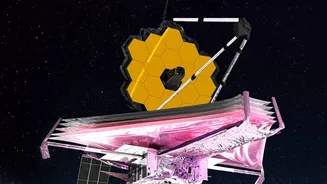
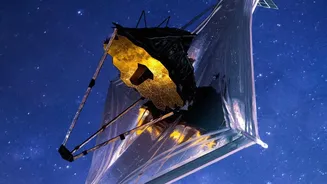
The James Webb Space Telescope (JWST) has revolutionised our ability to study these distant worlds. Its power lies in its sensitivity to infrared light. When a planet passes in front of its star from our perspective, a tiny fraction of the starlight filters through the planet's atmosphere. Different gas molecules in that atmosphere absorb specific wavelengths of light. By capturing this light with instruments like its Near-Infrared Spectrograph (NIRSpec) and Mid-Infrared Instrument (MIRI), astronomers can create a spectrum—a sort of chemical fingerprint—that reveals what the atmosphere is made of. This technique, called transmission spectroscopy, is how Webb is able to analyse the air of worlds light-years away.
A Case Study: 55 Cancri e
One of the most exciting recent subjects is a super-earth named 55 Cancri e, located 41 light-years away. This planet is so close to its star that a year lasts less than a day, and its surface is likely a bubbling ocean of lava. For years, scientists debated whether a planet under such intense heat and radiation could even hold onto an atmosphere. Recent observations from JWST have provided the best evidence yet that it does. The data suggests an atmosphere rich in gases like carbon monoxide and potentially carbon dioxide. This atmosphere is believed to be a 'secondary' one, meaning it's not the original atmosphere the planet formed with, but one that is actively being replenished by gases bubbling out of the magma ocean below.
Peeling Back the Layers
So, what does this tell us about atmospheric 'layers'? The key clue came from temperature measurements. If 55 Cancri e were a bare rock, its dayside temperature was expected to be around 2,200 degrees Celsius. Instead, JWST measured a significantly cooler temperature of about 1,540 degrees Celsius. This suggests that an atmosphere is present and circulating, moving heat around the planet instead of it just radiating directly into space. The presence of a substantial atmosphere, which absorbs and re-radiates heat, acts as a blanket. While not distinct 'layers' like Earth's troposphere and stratosphere, this dynamic suggests a complex system where gases from the interior interact with the surface and space, creating a thermally complex environment rather than a simple, uniform hot rock. This is a crucial step in understanding planetary climate systems beyond our own.
Why Alien Atmospheres Matter
The discovery of a robust atmosphere on a world as extreme as 55 Cancri e is a game-changer. It challenges the long-held assumption that small, rocky planets orbiting very close to their stars would have their atmospheres completely stripped away by stellar radiation. Finding that these planets can maintain or replenish their atmospheres opens up a whole new range of worlds for study. An atmosphere is a critical component for potential habitability, as it can regulate temperature, protect a planet's surface from harmful radiation, and create pressure that could allow for liquid water. While a lava world like 55 Cancri e is not habitable, proving that such a planet can have an atmosphere is a vital piece of the puzzle in the search for life elsewhere. It shows that the ingredients for complex planetary systems are more resilient than we once thought.