




A Telescope Unlike Any Other
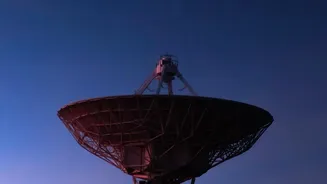
Located in British Columbia, Canada, the Canadian Hydrogen Intensity Mapping Experiment (CHIME) doesn't look like a typical telescope. It has no moving parts, resembling four massive metal half-pipes. Instead of tracking single objects, it surveys the entire
northern sky every day as the Earth rotates. While it has become famous for detecting hundreds of mysterious 'fast radio bursts' (FRBs), its primary mission is even more ambitious: to create the largest-volume 3D map of the universe ever made. This map won't be made of starlight, but from the faint radio waves emitted by the most common element in the cosmos: hydrogen.
The Universe's Greatest Mystery
For decades, astronomers have known the universe is expanding. But in the late 1990s, they discovered something shocking: the expansion is speeding up. It's as if you threw a ball in the air and instead of slowing down, it started flying upwards faster and faster. Scientists call the unknown force causing this acceleration 'dark energy'. It's believed to make up nearly 70% of everything in the universe, yet we know almost nothing about it. Understanding its nature is one of the single biggest challenges in modern physics, as it will determine the ultimate fate of our cosmos.
Listening for Ancient Hydrogen
This is where CHIME's unique approach comes in. Neutral hydrogen gas, the raw material for stars, naturally emits a faint radio signal at a specific wavelength of 21 centimetres. As the universe expands, light waves from distant objects get stretched out. By tuning into these stretched, or 'redshifted', signals, CHIME can effectively look back in time. The signals it seeks come from a period when the universe was about half its current age, a crucial era when dark energy began to dominate cosmic expansion. This technique is called 'hydrogen intensity mapping'. Instead of resolving individual galaxies, which is slow and costly, CHIME measures the combined glow of hydrogen from enormous patches of the sky, creating a low-resolution but incredibly vast map of matter.
Creating a Cosmic Yardstick
By mapping how hydrogen was clustered across space billions of years ago, astronomers can trace the history of cosmic expansion in unprecedented detail. They are specifically looking for the faint imprint of something called Baryon Acoustic Oscillations (BAOs). These are like spherical ripples frozen in the fabric of space from the very early universe. The original size of these ripples is known, so by measuring their apparent size at different cosmic distances, scientists have a 'standard ruler' to chart the universe's expansion history. Seeing how this expansion has changed over billions of years will allow scientists to test competing theories about what dark energy is and how it behaves.
A Landmark Achievement and Future Hopes
Recently, in a milestone achievement, the CHIME collaboration announced it had successfully detected the faint hydrogen signal using its own data alone, without needing to cross-reference with other, more expensive galaxy surveys. This proves the power and efficiency of the intensity mapping technique. The initial detection used data from just 94 nights in 2019, but scientists have nearly seven years of observations archived and ready for analysis. By digging deeper into this data, astronomers hope to map hydrogen even further back in time, to when the universe was just 3 billion years old. This new window into our cosmic past promises not only to illuminate the nature of dark energy but also to refine our understanding of how galaxies form and evolve.