



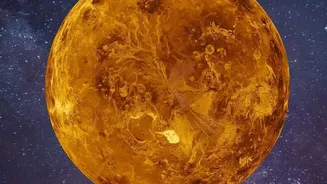
The Sun’s Two Faces
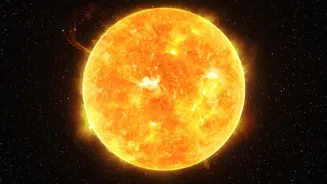
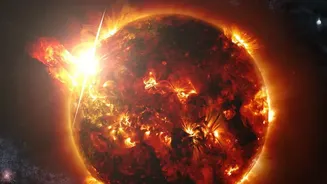
We often use the terms solar flare and coronal mass ejection (CME) interchangeably, but they are different events that can occur together. A solar flare is an enormous, sudden burst of radiation—essentially a brilliant flash of light. A CME, on the other
hand, is a massive explosion of plasma and magnetic fields from the sun's outer atmosphere, the corona. Think of it like a cannon: the flare is the bright muzzle flash, while the CME is the cannonball. This 'cannonball' of charged particles can travel at speeds from 250 to over 3000 km/s and can reach Earth in as little as 15-18 hours. While solar flares can disrupt radio communications on the sunlit side of Earth, it's the Earth-directed CMEs that pose the greatest threat to our physical infrastructure.
Our Eyes in the Sky
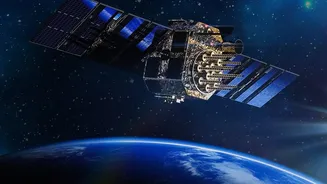
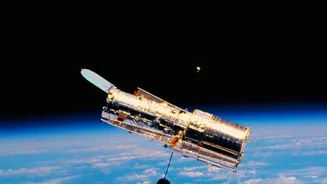
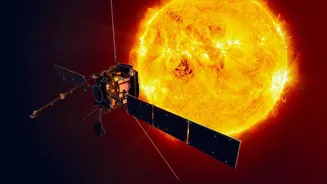
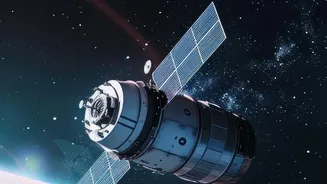
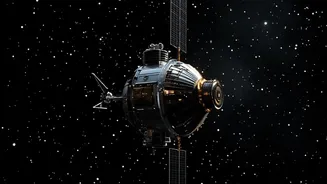
This is where solar forecasting comes in. For decades, a fleet of international satellites has been our early warning system, watching the Sun for any signs of trouble. Key among these are coronagraphs—instruments that block the Sun's bright face to see the much fainter corona, much like using your hand to block the sun to see something next to it. NASA’s Solar and Heliospheric Observatory (SOHO) has been a workhorse in this field. Another crucial satellite is the Deep Space Climate Observatory (DSCOVR), which sits at a special point in space about 1.5 million kilometres from Earth called Lagrange point 1 (L1). From this vantage point, it can directly measure the properties of an incoming CME about 15 to 60 minutes before it hits our planet, providing a final, crucial warning.
India’s Solar Shield: Aditya-L1
India has recently become a major player in this global effort. In 2023, ISRO successfully launched its first dedicated solar observatory, Aditya-L1. The spacecraft journeyed to the same strategic L1 point as DSCOVR, giving India its own independent and continuous view of the sun. Aditya-L1 is equipped with seven sophisticated instruments designed to study the sun's atmosphere and the solar wind. This isn't just about contributing to global science; it's a matter of national security and economic stability. By having its own data stream, India can generate its own space weather alerts and better protect its rapidly growing digital economy, satellite constellations, and critical infrastructure from solar threats.
How a Solar Storm Disrupts the Grid
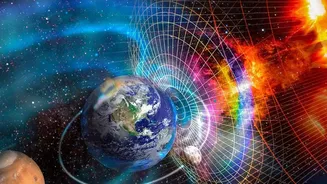
When a CME slams into Earth's magnetic field, it causes it to shake and vibrate. This rapid change in the magnetic field induces powerful electrical currents in the ground, known as Geomagnetically Induced Currents (GICs). These currents are not like the normal AC power in our homes; they are more like DC current. Long power transmission lines act like giant antennas, picking up these GICs, which then flow into the massive transformers at electrical substations. These transformers are designed for AC power, and the influx of DC from a GIC can cause them to overheat, saturate, and even melt. The result can be widespread power outages, and replacing these huge, custom-built transformers can take months or even years.
From Forecast to Action
This is why the forecast is so critical. An early warning from satellites like Aditya-L1 and SOHO gives power grid operators precious time—hours or even a few days—to prepare. They can take protective measures such as reducing the load on vulnerable transformers, redirecting power, or even temporarily taking certain parts of the grid offline to prevent a cascading failure. The warning from a satellite at the L1 point, though short, gives operators a final confirmation to enact their emergency plans just before the storm hits. It's a race against time, turning a potential catastrophe into a manageable event. Without these eyes on the sun, a major solar storm could strike without warning, leaving millions in the dark.