


For years, the promise of AI has been everywhere, but the reality of truly capable physical robots has lagged behind. A startup named Eka Robotics is tackling this challenge head-on, aiming to give robots the 'common sense' of touch.
The Great A.I. Disconnect
Artificial intelligence
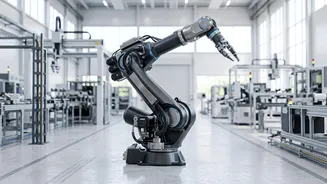
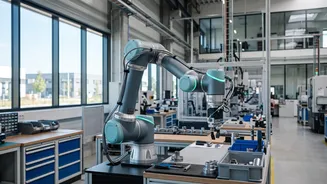
can write poetry, compose music, and beat grandmasters at chess. Yet, ask a robot to pick a delicate piece of fruit from a bin or plug a cable into a socket, and the task becomes monumentally difficult. This is the disconnect at the heart of modern robotics. While AI models are incredibly 'smart' in a digital sense, translating that intelligence into fluid, reliable physical action in the messy, unpredictable real world is a huge challenge. Traditional industrial robots thrive in structured environments, like a car assembly line where every part is in the exact same place, every time. But the moment conditions change—a part is slightly out of place, the lighting shifts, or an object is slippery—these systems often fail. This 'generality vs. performance' gap has prevented robots from taking on countless tasks that require dexterity and adaptation.
Enter Eka Robotics
Eka Robotics, a startup founded by pioneers from leading institutions like MIT, Berkeley, and DeepMind, was created to solve this exact problem. The company’s mission is to build a foundational AI model for physical work, creating general-purpose robots that can perform tasks beyond human capabilities while working safely alongside people. Just recently, the Cambridge, Massachusetts-based company announced a massive $150 million Series A funding round led by major investors Andreessen Horowitz (a16z) and F-Prime, valuing the startup at $1.45 billion. This significant investment underscores the industry's belief that Eka's approach could be a breakthrough.
It's All About the Feel
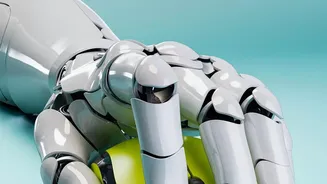
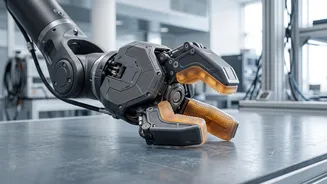
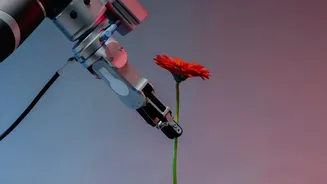
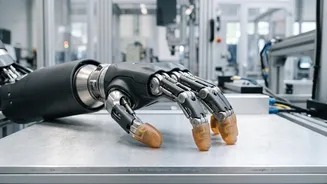
Eka's key innovation is its Vision-Force-Action (VFA) model. Instead of relying on vision alone, Eka’s robots combine what they 'see' with what they 'feel'. Their systems use force-sensitive grippers that provide real-time feedback. Think about how you pick up an egg; you don't just look at it, you feel its weight and fragility, adjusting your grip pressure instinctively. Eka is building this physical intuition into its AI. This allows a robot to correct a slipping grasp, sense resistance when inserting a part, and handle objects with a dexterity that vision-only systems lack. Co-founder Pulkit Agrawal notes that vision gets you close, but solving the 'last millimeter problem' happens through force.
Training Smarter, Not Harder
Another key differentiator is how Eka trains its robots. Instead of relying on countless hours of human demonstrations, the company uses reinforcement learning in a physics simulator. In this virtual world, Eka can generate thousands of hours of robot experience in just minutes, teaching the AI to handle millions of variations in object position, friction, and contact dynamics. This 'sim-to-real' approach allows its policies to be tested against countless failure scenarios before ever being deployed on physical hardware, making the learning process vastly more scalable and efficient. The result is a single AI model that can generalize across different objects and tasks without extensive retraining.
The Future of Physical Work
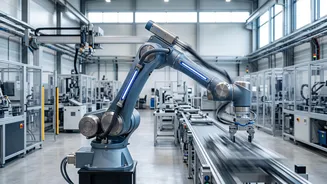
The performance metrics are already impressive. Eka reports its robots can perform pick-and-place tasks at a rate of 1,500 items per hour with over 95% accuracy, more than double the speed of a human worker. The same system that can sort items in a warehouse can also perform delicate tasks like screwing in a lightbulb or inserting wires. The new funding will help Eka scale its technology and accelerate customer deployments, moving from lab demos to sustained, reliable performance on factory floors and in warehouses. While the road from a successful demo to a robot that can run for a year without breaking down is long, Eka's focus on mastering physics, not just mimicking humans, represents a fundamental shift.