


A Telescope's Unflinching Gaze
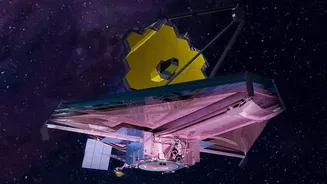
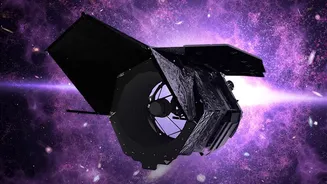
The James Webb Space Telescope, a collaboration between NASA, the European Space Agency, and the Canadian Space Agency, has turned its powerful instruments toward some of the most tantalizing exoplanets discovered to date. A key focus has been on rocky,
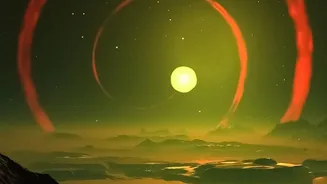
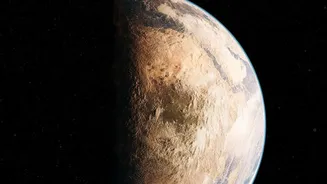
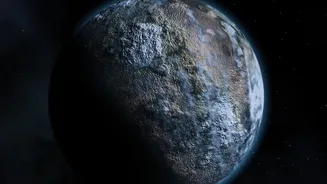
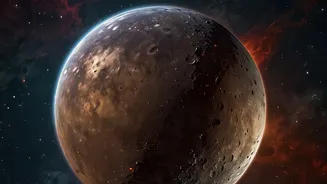
Earth-sized worlds orbiting nearby red dwarf stars. These stars are the most common type in our galaxy, making their planetary systems prime real estate in the hunt for habitable worlds. Systems like TRAPPIST-1, located just 40 light-years away, have been a top priority. Scientists have used the telescope's spectrographs to hunt for the chemical fingerprints of an atmosphere as these planets pass in front of their host star. The results are painting a stark picture: many of these worlds appear to be bare rock, completely devoid of the gaseous envelope needed to support life as we know it.
The Case of the Missing Atmosphere
When a planet with an atmosphere transits its star, starlight filters through the gas, and molecules within that atmosphere absorb specific wavelengths of light. This leaves a tell-tale barcode, or spectral signature, that the JWST can detect. For several planets, including those in the TRAPPIST-1 system like TRAPPIST-1 d, these observations have come up empty. Scientists looked for signs of carbon dioxide, water, and methane but found nothing substantial. This absence is a profound finding. It suggests that even if a planet is in the so-called "habitable zone"—the orbital ring where temperatures could allow for liquid water—it may be uninhabitable if it cannot hold onto its atmosphere. This intense radiation pressure from a star can be powerful enough to completely strip a planet's atmosphere away, a process known as atmospheric escape.
The Violent Nature of Red Dwarf Stars
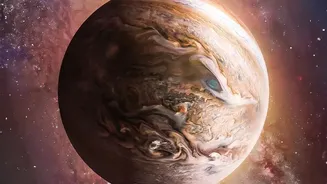
The primary culprit behind this atmospheric loss appears to be the very stars these planets orbit. Red dwarfs, while smaller and cooler than our sun, are notoriously volatile, especially in their youth. They can unleash powerful flares of high-energy radiation and stellar winds. Because the habitable zone around a cool red dwarf is much closer than it is for a star like our sun, planets within it are subjected to an immense battering. The intense radiation can heat the upper atmosphere of a planet, giving gas molecules enough energy to escape the planet's gravity and drift into space. Over millions of years, this can erode an entire atmosphere, leaving the planet exposed and sterile. This has been observed in dramatic fashion with planets like WASP-107b, a 'super-puff' planet seen shedding its atmosphere in real time.
Redefining the Search for Habitable Worlds
These findings force a major refinement of the concept of a habitable zone. For decades, it was primarily defined by temperature—not too hot, not too cold, but just right for liquid water. JWST's data adds a critical new variable: atmospheric stability. A planet's ability to retain its atmosphere depends on several factors, including its size, mass, and the intensity of its host star's radiation. Recent modeling suggests a rocky world needs to be at least the size of Mars to maintain an atmosphere over billions of years. For planets orbiting volatile red dwarfs, even Earth-sized worlds may be too small or too close to withstand the stellar onslaught. This means that a significant number of planets previously considered top candidates for habitability may need to be re-evaluated.
A More Focused Hunt for Life
While ruling out worlds might seem like a setback, it is actually a crucial step forward. Science progresses by eliminating possibilities. By understanding the limits of survival, astronomers can narrow their focus and use precious telescope time more efficiently. Instead of randomly searching any planet in a habitable zone, they can now prioritize worlds that are large enough and orbit stars that are stable enough to allow an atmosphere to persist. The search for life is not just about finding a planet of the right size at the right distance; it's about finding one in the right cosmic neighborhood, with a parent star that nurtures rather than destroys. The JWST's findings are not an end to the story, but a vital new chapter that equips scientists with the knowledge to hunt smarter, not just harder.