


Beyond Digital: The Rise of Physical AI
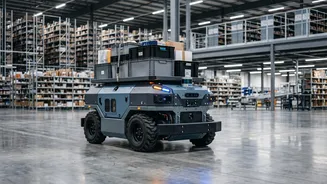
Artificial intelligence has reshaped digital industries, from search engines to chatbots, but its impact on the physical world has been slower. The reason is simple: the real world is messy and unpredictable. Unlike a controlled digital environment, a factory
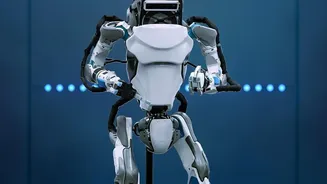
floor or a warehouse has constantly changing light, textures, and object positions. 'Physical AI' refers to systems that can perceive, reason, and act in this complex reality. This means creating robots that don't just follow pre-programmed instructions but can adapt to a shifting environment in real-time, a challenge that has stumped roboticists for decades.
Eka's Vision-Force-Action Model
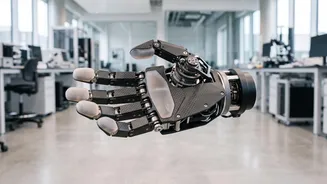
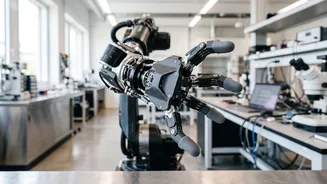
Enter Eka Robotics, a startup co-founded by MIT professor Pulkit Agrawal and former Google DeepMind researcher Tuomas Haarnoja. The company recently announced a $150 million Series A funding round led by major investors like Andreessen Horowitz. Their mission is to create general-purpose robots that can finally bridge the gap between lab demonstrations and reliable industrial deployment. The key to their approach is a 'Vision-Force-Action' (VFA) model. Instead of relying on vision alone, Eka’s robots use custom-built grippers with advanced force sensors. This allows the robot to 'feel' an object, correcting its grip if it starts to slip or applying just the right amount of pressure—a crucial step in handling delicate or varied items.
Learning from Physics, Not Just Mimicry
Many of today's robots are trained by mimicking human actions. Eka takes a different path. The company uses reinforcement learning in a simulated environment, allowing its AI to gain thousands of hours of experience in minutes by mastering the laws of physics. This virtual training teaches the robot an 'intuition' for physical tasks. The result is a system that can generalize its learning to new objects and situations it has never encountered before. According to the company, their robots can already achieve 1,500 picks per hour in certain tasks, more than double the average human rate of about 600, with over 95% accuracy. The same robot can handle diverse tasks like picking fragile objects, screwing in a lightbulb, or inserting wires.
A 'ChatGPT Moment' for the Physical World?
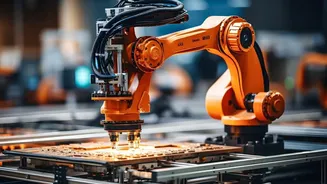
The capabilities demonstrated by Eka have led some to suggest we are approaching a 'ChatGPT moment' for the physical world—a point where robots become dramatically more versatile and useful. The goal is to break the trade-off between performance and generality that has long held back industrial automation. Currently, most industrial robots are highly efficient but can only perform one specific, repetitive task. General-purpose robots, on the other hand, have historically been too slow or unreliable for commercial use. By combining speed with adaptability, Eka aims to automate tasks that were previously too complex or variable for robots, such as packing mixed goods in a warehouse or handling delicate components in electronics assembly.
Impact on India's Industrial Future
For India, this technology arrives at a critical time. The nation's manufacturing and logistics sectors are rapidly expanding, driven by initiatives like 'Make in India' and global supply chain diversification. However, to compete globally, Indian factories need to enhance productivity and quality. While India's robot density remains low compared to other major economies, the adoption of automation is growing at the fastest rate in Asia. Technologies like Eka's could accelerate this transition, not by replacing human workers wholesale, but by augmenting them. Robots can take over strenuous, repetitive, or dangerous jobs, allowing human operators to focus on more complex, value-added tasks. This modular approach to automation, where humans and robots work side-by-side, is seen as the most viable path forward for India’s diverse manufacturing ecosystem.